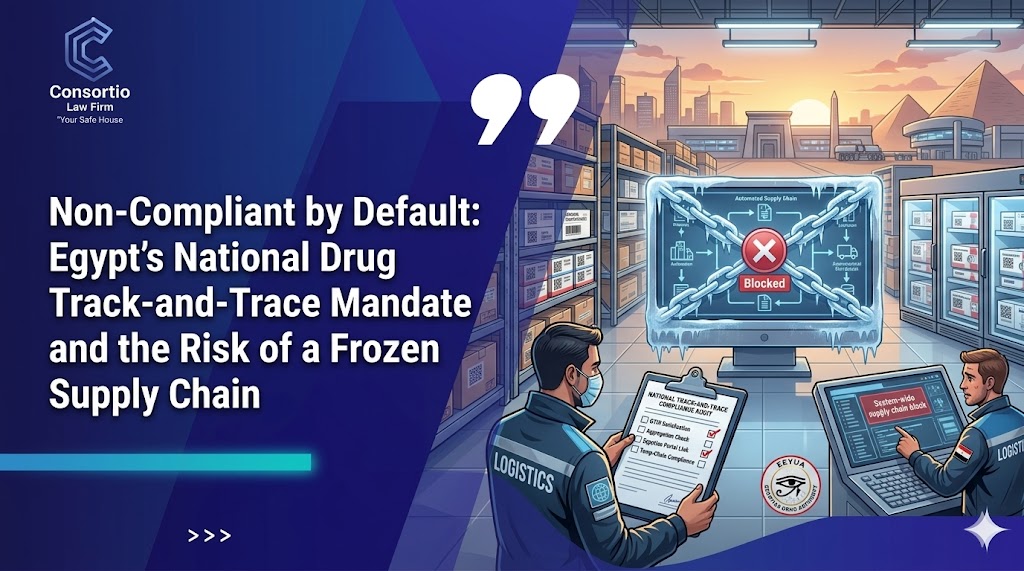
Egypt’s drug track-and-trace regime has moved from aspiration to enforcement. Under the Egyptian Drug Authority’s Decrees No. 475 and No. 804 of 2025, a single coding or data failure can render an otherwise sound product legally “non-compliant” — and that status can suspend the product’s circulation, suspend its supply, and lead to seizure and destruction of the stock. For every operator in the Egyptian drug supply chain, this is now the highest live compliance risk.
A batch that looks perfect — and is illegal anyway
Picture a finished batch that passes every quality check: correct formulation, valid shelf life, clean release documentation. Under the new regime, none of that is enough. If the outer pack does not carry a compliant 2D DataMatrix, if the serial number was duplicated, if the commissioning event was not registered, or if the aggregation data never reached the national platform, the product meets the regulatory definition of a “Non-Compliant Product” — and it can be impounded, its circulation halted, and its onward supply suspended.
That definition is set out in the Regulatory Guide itself:
EDA Decree No. 804 of 2025 — Regulatory Guide, Article 2 (Definitions): “Non-Compliant Product: any medicine pack that breaches the drug-traceability requirements as to coding, registration, or movement between entities.”
This is the structural shift that makes traceability the dominant compliance risk in the Egyptian market today: compliance is no longer a property of the medicine. It is a property of the data that travels with it.
Egypt’s drug track-and-trace system: what it is and who it binds
The Egyptian Drug Authority (EDA) has established a National Unified Electronic Drug Track-and-Trace System for human and biological medicines, designed to follow every pack across the supply chain — from manufacture or import, through distribution and storage, to dispensing to the patient — using international serialization and aggregation standards built on the EPCIS event protocol.
The obligation is not narrow. The issuing article of the Regulatory Guide fixes its reach across the entire chain:
EDA Decree No. 804 of 2025 — Issuing Article 1: “The provisions of the Regulatory Guide annexed to this Decree apply to all entities operating in the Egyptian drug market — whether manufacturers, importers, distributors, marketing-authorization holders, or logistics-services companies. Its provisions also apply to all pharmaceutical establishments referred to in Article 10 of the Pharmacy Practice Law. The entities referred to in this Article shall implement the provisions of the Guide, each within its field of activity.”
There is no part of the chain that sits outside it. A manufacturer that serializes perfectly can still be exposed if its distributor or 3PL fails to record the corresponding events. A narrow set of categories is carved out — unregistered imports supplied on specific request, clinical-trial product, and free medical or research samples (Regulatory Guide, Article 5) — but these are exceptions that prove the rule.
The legal architecture
This is not a rule that appeared overnight. It is the enforcement layer of a regulatory trajectory nearly a decade in the making:
- Ministerial Decree No. 29 of 2016 first activated a national “Track and Trace” project for pharmaceutical products and made unified coding mandatory across manufacturers, companies, distributors, importers, warehouses and all pharmaceutical establishments — for both locally made and imported product, and reaching not only human drugs but biologicals, food supplements, herbal and veterinary products, and pesticides/disinfectants (controls, Article 1).
- EDA Decree No. 499 of 2021 extended unified coding to medical supplies and devices, transacted through the “Device Me” platform.
- EDA Decree No. 161 of 2025 modernized the 2016 and 2021 frameworks, replacing the single GTIN barcode standard with a unified unique-identifier coding system.
- EDA Decree No. 475 of 2025 formally established the National Unified Electronic Drug Track-and-Trace System, set its phased application, and authorized inspection-led seizure of violating product.
- EDA Decree No. 804 of 2025 issued the binding Regulatory Guide that operationalizes the system — defining the obligations, the events, the technical integration, the implementation dates, and the penalties.
All of this rests on the Pharmacy Practice Law (Law No. 127 of 1955) and the Egyptian Drug Authority Law (Law No. 151 of 2019), which together give the EDA its gatekeeping power over the market.
The coding mandate, and the prohibition behind it
The foundational obligation — unified coding on every pack — and the specification of what that code must contain are set in the 2016 decree as amended in 2025:
Ministerial Decree No. 29 of 2016 — controls, Article 2 (as amended by Decree No. 161 of 2025): “Manufacturers, companies, distributors, importers and warehouses of products within the EDA’s competence, and pharmaceutical establishments of all kinds dealing with the Egyptian market, shall use a unified goods-and-services coding system based on unique identifier numbers, for all EDA-scope products traded in the local market — whether locally made, imported finished, or made abroad and filled and packaged in factories inside the country.”
The code must carry, per controls Article 3, the unique product identifier, the expiry date, the batch number, and a random serial number unique to each pack. And the consequence of trading without it is stated as a flat prohibition:
Ministerial Decree No. 29 of 2016 — controls, Article 6: “Trading any pharmaceutical product referred to above in the local market is prohibited if it does not bear the said international code with the aforementioned specifications, once the implementation phases end, in accordance with the timetable referred to in Article 4.”
For medical supplies and devices, the parallel obligation runs through the “Device Me” platform:
EDA Decree No. 499 of 2021 — Article 1 (as amended by Decree No. 161 of 2025): “Manufacturers, companies, distributors, importers and warehouses of medical supplies of all kinds and sources dealing in the Egyptian market shall use a unified goods-and-services coding system based on unique identifier numbers from any of the bodies accredited by the International Medical Device Regulators Forum (IMDRF), for all medical supplies traded in the local market, through the ‘Device Me’ electronic platform.”
The obligations are operational, technical, and continuous
The Regulatory Guide does not ask for a one-off filing — it imposes a permanent operating standard on every executing entity. Article 7 lists thirteen operational and technical obligations common to all participants; three of the sharpest are worth quoting because they are the ones most often overlooked:
EDA Decree No. 804 of 2025 — Regulatory Guide, Article 7 (extracts): “(9) No unauthorized delegation: no external party may be given access to the system or the data without official EDA approval. (10) Linking financial data to events: every financial transaction (such as a sales invoice) tied to the product represented by its product code must be linked to the sequential events recorded on the platform, to ensure transparency and regulatory conformity. (12) Immediate reporting: the Authority must be notified of any technical faults, breaches, or data errors immediately, so corrective measures can be taken.”
For manufacturers — the first node, and the one that starts serialization — Article 8 is more demanding still: obtain a unique product code (distinct for each marketing pack size); print a 2D DataMatrix carrying the product code, the unique serial number, the expiry date and the batch number; verify at the commissioning event that no code-and-serial combination is duplicated; perform aggregation linking individual packs to higher packaging units via SSCC; integrate production lines and ERP/MES systems with the platform on EPCIS; and transmit every event in real time. The Guide is explicit that a shipping-event failure is a legal exposure, not a technicality:
EDA Decree No. 804 of 2025 — Regulatory Guide, Article 8 (extract): “Real-time reporting obligation: delay in sending any event is prohibited, including the requirement to identify the receiving party precisely at the shipping event, so as to ensure technical coordination with distributors and warehouses, to keep packs traceable and prevent their loss at any stage — which shields the manufacturer from legal liability.”
The duties cascade down the chain: distributors and warehouses must scan and register each receiving event within a maximum of 48 hours, failing which a regulatory alert is triggered (Article 10); pharmacies and hospitals must verify each pack on the platform before dispensing and may not dispense a pack whose code cannot be verified (Articles 11 and 12). Every node also bears the system’s operational costs. A company can be “non-compliant” not because its medicine is unsafe, but because its invoice was never linked to a serialization event.
Why this is the highest risk: the consequence is not just a fine
What elevates traceability above every other current exposure is the nature of the sanction. Article 15 of the Regulatory Guide sets out both an inspection-seizure power and a graduated enforcement ladder — quoted here in full because it is the heart of the risk:
EDA Decree No. 804 of 2025 — Regulatory Guide, Article 15: “The Central Administration for Inspection of Pharmaceutical Establishments shall seize and impound products produced or imported after the dates specified in Article 5 of Decree No. 475 of 2025 in breach of this Decree and the Regulatory Guide. The Head of the Central Administration for Inspection may, on a technical memorandum from the competent administration, order the destruction of the violating products or approve a corrective plan to return them to circulation after the causes of the breach are corrected, subject to payment of the prescribed fee for monitoring the corrective plan. All entities in the drug supply chain shall fully comply with the requirements of the National Unified Drug Track-and-Trace System. In the event of non-compliance with, or breach of, any technical or regulatory requirement, the following penalties apply — and without prejudice to criminal and disciplinary liability: (1) an official written warning from the EDA to correct the violation within a set period; (2) temporary suspension of circulation of the violating products until the system’s requirements are met; (3) temporary suspension of supply of products to the violating entity until a corrective plan is approved; (4) imposition of financial penalties as determined by the schedule of penalties and violations.”
For a manufacturer or distributor, “your product cannot move and you cannot supply the market” is not a cost line. It is a revenue stoppage, a stock-out liability to hospitals and pharmacies, a destruction-of-inventory risk, and — expressly — a matter that does not displace separate criminal and disciplinary liability. All of it can be triggered by a data defect that quality control would never catch.
Why now: the deadlines are live
The phased application is no longer abstract. The Regulatory Guide fixes the dates:
The phased application is not abstract, and the dates do not live only in guidance — they are fixed in the establishing decree itself, which also bars circulation of post-deadline product that has not been enrolled in the system:
EDA Decree No. 475 of 2025 — Article 5: “The provisions of this Decree apply to all imported finished human preparations as of 1 February 2026, and to those packaged and/or filled and/or produced locally as of 1 August 2026 — provided that batches produced or imported by those dates remain, as the case may be, tradable in the market until their expiry. Gradual application within the set period shall take account of the dosage form and/or therapeutic group of the products concerned, all as set out in the Regulatory Guide. Trading preparations produced or imported after the dates referred to in the first paragraph of this Article is prohibited unless they have been enrolled in the drug-traceability system.”
The Regulatory Guide (Article 14) restates the same two dates, adding that the detailed rollout follows a timetable issued by the EDA Chairman.
Imported finished product is therefore in scope from 1 February 2026, and locally produced or packaged product from 1 August 2026. For importers, the Guide allows a transitional NFC electronic label between 1 February and 1 August 2026 where direct printing is not yet feasible, after which 2D Data Matrix printing becomes mandatory (Article 9). There is also a narrow emergency-circumstances exception (Decree No. 475 of 2025, Article 7), but it must be justified by a technical memorandum and approved by the Authority — it is not a planning tool. For most operators the practical position is simple: the readiness work has to be finished before the relevant phase date, not started at it.
What readiness actually requires
Compliance here is a cross-functional programme, not a regulatory-affairs task. It reaches into manufacturing-line hardware (DataMatrix printing, aggregation, vision systems), IT systems integration (ERP/MES/WMS to EPCIS), master-data governance for product and location codes, finance (the Article 7 requirement to link each sales transaction to a recorded event), quality systems, and contracts with distributors, 3PLs and importers whose event-reporting failures become your exposure. The most common gaps are not in serialization printing — they are in aggregation accuracy, real-time event transmission, financial-data linkage, the 48-hour receiving window, and the technical and contractual readiness of downstream partners.
How Consortio helps with Egypt drug track-and-trace compliance
Consortio works with manufacturers, importers, distributors and marketing-authorization holders to convert the EDA traceability mandate from a liability into a controlled programme. Our support typically includes a track-and-trace readiness and gap assessment mapped against the specific articles of Decrees No. 475 and No. 804 of 2025, a phased remediation roadmap aligned to the 1 February and 1 August 2026 deadlines, technical and process design for serialization, aggregation, EPCIS integration and financial-event linkage, supply-chain partner due diligence so that downstream failures do not become your seizure, and ongoing regulatory monitoring as the Authority updates the Guide. The objective is straightforward: that no product you make, import or distribute is ever “non-compliant by default.”
To arrange a confidential readiness assessment, contact the Consortio compliance team.
Legal basis — the articles this risk is derived from
- EDA Decree No. 804 of 2025 (the binding Regulatory Guide): Issuing Article 1 (scope — all market entities and all pharmaceutical establishments under Article 10 of Law 127/1955); Article 2 (definitions, incl. “Non-Compliant Product”); Article 4 (entities within scope); Article 5 (categories exempt from application — unregistered imports on specific request, clinical-trial product, free medical/research samples); Article 7 (thirteen operational/technical obligations, incl. items 9, 10, 12); Article 8 (manufacturer obligations, incl. commissioning verification, aggregation/SSCC, EPCIS integration, shipping-event reporting, toll-manufacturing co-responsibility); Articles 10–12 (distributor 48-hour receiving scan; verification before dispensing by pharmacies and hospitals); Article 13 (registration and accreditation); Article 14 (phased dates: imports from 1 Feb 2026, local from 1 Aug 2026); Article 15 (seizure, destruction/corrective plan, and the four-step penalty ladder, without prejudice to criminal and disciplinary liability); Article 16 (sequential EPCIS events).
- EDA Decree No. 475 of 2025: Article 5 — the phased implementation dates themselves: imported finished (human) product from 1 February 2026; locally packaged/filled/produced from 1 August 2026; graduated by dosage form/therapeutic group; batches produced or imported by those dates tradable until expiry; and an express prohibition on circulating post-deadline product unless enrolled in the system (the Guide, Article 14, restates these dates); Article 6 (seizure of violating product; destruction or corrective plan); Article 7 (narrow emergency exception).
- Ministerial Decree No. 29 of 2016, as amended by EDA Decree No. 161 of 2025: controls Article 1 (scope of “pharmaceutical product”); Article 2 (mandatory unified coding); Article 3 (coding specification); Article 5 (printing/scanning and data-supply duties); Article 6 (trading prohibition for un-coded product); Article 7 (quarterly monitoring).
- EDA Decree No. 499 of 2021 (as amended by Decree No. 161 of 2025): Article 1 (unified IMDRF-based coding for medical supplies via “Device Me”).
- Parent legislation: Law No. 127 of 1955 (Pharmacy Practice) and Law No. 151 of 2019 (Egyptian Drug Authority).
This article is general information on published Egyptian legislation and is not legal advice; specific situations should be assessed against the current official text of the relevant decrees (as published in the Official Gazette / Al-Waqa’i’ al-Misriyya) and with qualified counsel. Statutory quotations are Consortio’s working English translations of the official Arabic text, which governs. Decree provisions, transitional windows and phased deadlines are updated periodically by the Egyptian Drug Authority.