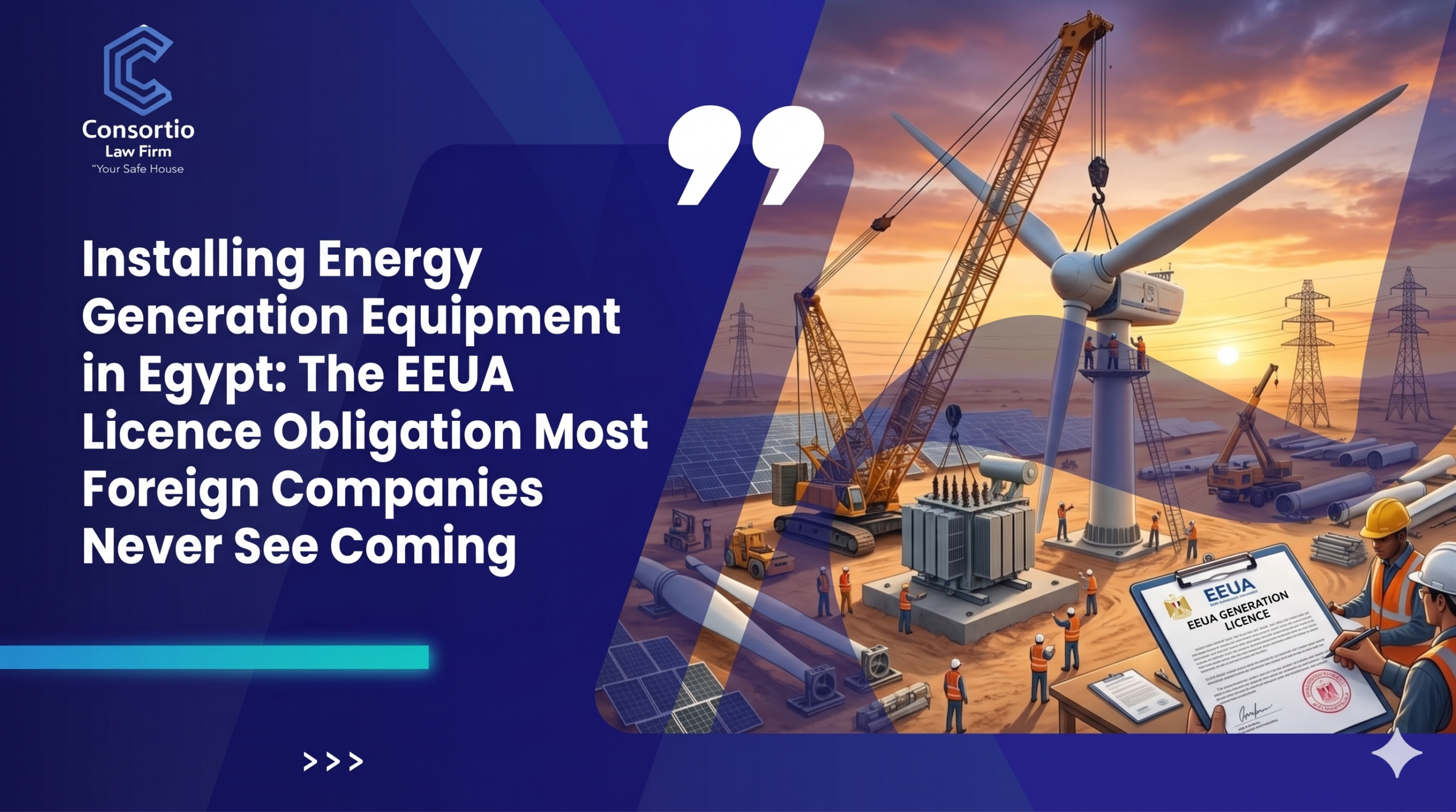
A European company wins a contract to install waste heat recovery systems at an Egyptian petroleum facility. The equipment is commissioned. It begins generating electricity from thermal waste that would otherwise be lost. The facility’s energy costs drop. Both parties are satisfied.
Six months later, the Egyptian regulatory authority opens an inquiry. The company has been generating electricity in Egypt without a licence. That is a criminal offence under Egyptian law. The penalty is imprisonment between six months and three years, a fine of up to one million Egyptian pounds, or both. The company’s Egypt country manager bears personal criminal liability.
The company had no idea the obligation existed.
The Licensing Obligation Under Article 13
Egyptian Electricity Law No. 87 of 2015 identifies three electricity activities that require a licence from the Electricity Utility and Consumer Protection Regulatory Agency (EEUA) before commencing operations. Those three activities are the production, distribution, and sale of electricity.
The law does not qualify production by scale, by sector, or by whether the electricity is sold commercially. It does not distinguish between a power station supplying the national grid and an industrial unit recovering thermal waste at a petroleum facility. If your equipment produces electricity in Egypt, Article 13 applies to you.
This surprises foreign technology companies consistently. Their engineers classify the equipment as industrial machinery. Their procurement teams focus on the installation contract. Their legal teams, if consulted at all, review the commercial agreement with the Egyptian counterpart. Nobody asks the regulatory question: does this equipment require a licence?
The answer is almost always yes — or it requires a formal assessment to confirm which regulatory pathway applies.
A Threshold Question Before the Licence Question: Corporate Form
Article 13 of the Law contains a requirement that rarely appears in foreign companies’ due diligence: any entity carrying out electricity production, distribution, or sale in Egypt must take the form of an Egyptian joint-stock company (شركة مساهمة مصرية).
A foreign company cannot hold an EEUA electricity production licence in its own name. Before the licensing question can be answered, the corporate structure question must be resolved. The vehicle for the Egyptian licensed activity must be established first.
The Permit and Licence Sequence
Article 13 creates two distinct instruments. The first is the permit (تصريح — tasrih), which authorises the commencement of construction or expansion works for an electricity activity. The second is the licence (ترخيص — tarkhis), which authorises the commencement of operations once construction is complete.
A company applying for a licence for the first time must first obtain a permit. Article 14 of the Law governs the application procedure for both instruments — it prescribes that applications are submitted on forms prepared by EEUA, accompanied by the required documents, and that EEUA must decide within sixty days of receiving a complete application. Article 14 is a procedural provision; it does not create a separate pathway for any category of project.
The application forms for permits are set out in Article 23 of the Executive Regulations (Ministerial Decision No. 230 of 2016). The application forms for licences are set out in Articles 25 and 26. For a production licence, Article 26 requires among other documents the final feasibility study, construction licences from the competent authorities, the grid connection agreement, and — critically — the approval of the Environmental Affairs Agency of the environmental impact assessment study. This EIA approval is a pre-licensing condition, not a post-commissioning formality. The EIA must be obtained before the licence application is submitted. The licence must be in place before operations commence.
The sequence matters. EIA first. EEUA licence application second. Licence issued. Operations begin. A company that commissions equipment first and addresses regulatory requirements afterward is not in a grey area. It is in breach.
The Own-Use Exemption: When No Licence Is Required
Article 13 of the Law and Article 21 of the Executive Regulations provide a complete exemption from permits and licences for producers of electricity for their own use, provided all three of the following conditions are satisfied simultaneously:
- The production station is wholly owned by the same legal entity that consumes the electricity it produces.
- The production station is not connected synchronously to the transmission or distribution network at a capacity exceeding 500 kilowatts; or if connected synchronously, the capacity does not exceed 500 kilowatts.
- The electricity producer is not party to any contract or agreement for the supply of electricity from the station to third parties.
The exemption is not automatic. It must be applied for. EEUA has the right to verify eligibility through document review and on-site inspection. If any condition lapses after the exemption is granted, the producer must notify EEUA within ten working days and obtain the necessary permit or licence.
For the waste heat recovery scenario described at the outset, whether this exemption applies depends on the specific configuration: the capacity of the unit, whether it connects to the national grid, and the contractual structure between the parties. It requires analysis, not assumption. A company that assumes the exemption applies without verifying the conditions is taking the same legal risk as a company that ignores the licensing obligation altogether.
The Cogeneration Framework: What Article 45 Does and Does Not Do
Article 45 of the Law creates an obligation on the network operator and licensed distributors to purchase or compensate for surplus electricity output from cogeneration units and recovered-energy production units with capacity below 50 megawatts, at prices and conditions approved by EEUA.
Article 46 provides that the network operator or licensed distributor must connect these units to their networks. The costs of any required network expansion fall on the network operator. The costs of connection to the network fall on the producer.
What Articles 45 and 46 do not do is exempt the equipment operator from its own licensing or permit obligations. The two questions — what the network operator must do with your electricity, and what you must do before you generate it — are answered by different provisions and run in parallel. A company that installs a cogeneration or waste heat recovery unit, reads Article 45, and concludes that the purchase obligation on the network operator is sufficient regulatory coverage for its own activities has made a legal error.
The Consequence of Getting It Wrong
Article 69 of the Electricity Law is direct. Operating in any of the three electricity activities identified in Article 13 without obtaining a licence from EEUA is a criminal offence. The penalty is imprisonment from six months to three years, a fine of up to one million Egyptian pounds, or either penalty at the court’s discretion. For a repeat offence, the penalty doubles.
Article 78 extends criminal liability beyond the company itself. The actual manager of the legal entity — the individual responsible for the entity’s operations in Egypt — bears the same criminal penalties for violations committed in the entity’s name and with their knowledge and intent. The legal entity bears joint and several liability for all financial penalties and damages.
This is not a risk that materialises only if something goes wrong operationally. The criminal exposure begins on the day electricity generation commences without a licence. It runs continuously for the duration of unlicensed operations. The size of the installation, the identity of the Egyptian counterpart, the status of the commercial contract, and the good faith of the operator are not defences under Article 69.
What This Means Before Operations Begin
The Egyptian electricity regulatory framework applies to any entity that produces, distributes, or sells electricity in Egypt. Industrial cogeneration equipment, waste heat recovery systems, on-site solar installations, and other distributed energy generation assets are all within its scope.
A foreign company bringing this type of equipment into Egypt under a state partnership agreement needs to answer four questions before the first module is commissioned:
- Corporate structure: Has an Egyptian joint-stock company been established to hold the licensed activity?
- Exemption eligibility: Do the conditions for the own-use exemption under Article 21 of the Executive Regulations apply to this specific installation?
- Regulatory pathway: If no exemption applies, which EEUA application process and timeline is required — and have the permit and licence been obtained in the correct sequence?
- EIA timing: Is the Environmental Affairs Agency approval in place in time for the licence application under Article 17(9) of the Law and Article 26(6) of the Executive Regulations?
These questions do not resolve themselves. The commercial contract with the Egyptian counterpart does not resolve them. The MoU with the state entity does not resolve them. They require direct engagement with Egyptian electricity regulation — ideally before the equipment leaves the country of origin.
The window to address this is before operations begin. Once electricity generation commences, the question changes from whether a licence is needed to whether an existing breach can be remediated and at what cost.
This article is prepared for general information purposes only. It does not constitute legal advice and does not create a lawyer-client relationship. Egyptian electricity regulation involves specific procedural requirements and deadlines that vary by installation type and corporate structure. For advice on a specific transaction, contact Consortio Law Firm.
© Consortio Law Firm — “Your Safe House” — Cairo, Egypt — www.consortiolawfirm.com