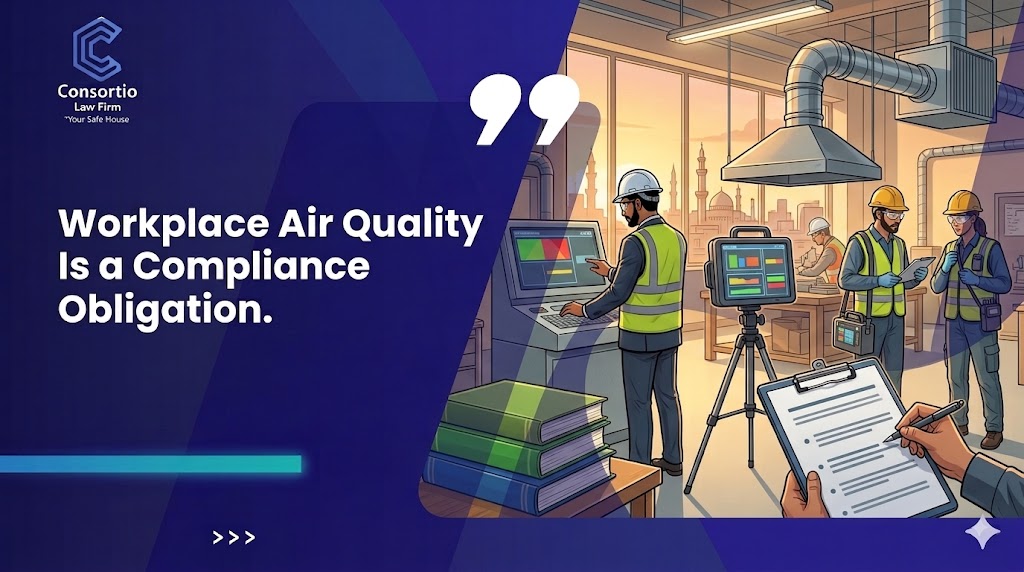
Workplace air quality in Egypt is a legal compliance issue when operations expose workers to gases, vapours or dust. A site’s environmental approval does not establish whether its controls adequately protect workers. That protection matters during normal production, maintenance and equipment faults.
An international group may already have a detailed health and safety system. However, the local review still needs to connect that system with Egyptian duties. It must also consider the substances the operation actually uses and its workplace evidence. Legal teams should make responsibilities clear and verifiable. Environmental and occupational specialists lead the corresponding technical work.
The duty covers ordinary activity and equipment faults
Article 43 of Environment Law No. 4 of 1994 places a duty on the establishment owner. The owner must take precautions and measures to prevent workplace air pollutants from leaking or escaping beyond the permitted limits. This duty expressly covers pollution from the activity itself and from equipment faults.
The provision connects worker protection with the selection of appropriate machinery, equipment, materials and fuels. The owner must also consider exposure duration and secure adequate ventilation, chimneys and other air-purification measures.
Consequently, the review cannot end with a purchasing specification or a general policy. It needs to consider how the team operates, maintains and uses the equipment in the actual space. A control that works under one operating condition may need reassessment when production or maintenance arrangements change.
Chemical records and labels are explicit controls
Article 45 of the Executive Regulations addresses protection from workplace chemicals, including gases, vapours and dust. It covers chemicals the operation uses or generates, as well as chemicals that leak into the workplace. The owner must retain chemical identification cards in a dedicated file. The owner must also ensure warning signs and hazard symbols appear on the chemicals in use.
The same provision requires ventilation procedures that purify the air and reduce emissions, by reference to Annex 8. Consequently, teams should not treat a missing chemical file and inadequate ventilation as unrelated housekeeping observations. Both affect the company’s ability to understand exposure and demonstrate the required protective measures.
Procurement, the local environmental or safety team and operations should reconcile the chemical inventory with the identification records. Meanwhile, the legal review should confirm who keeps those records available. It should also establish who checks labels when substances enter the operation or change.
The right measurement needs the right scope
A useful test result identifies the substance or pollutant and the relevant work activity. It also identifies the sampling method and assessment period. Without that context, a generic statement that air quality passed is difficult to evaluate.
The amended Article 13 bis of the Executive Regulations requires accredited laboratories to carry out environmental measurements. Their accreditation scope must cover the pollutants they measure. A familiar contractor’s name alone does not establish that its accreditation covers the particular measurement the company commissions.
Before appointing a laboratory, the technical team should identify the required tests and check the accreditation scope. Keep that evidence with the test report. The team must confirm the applicable substance-specific limits, units, exposure periods and annex conditions. It should not substitute a general threshold from another group facility for that assessment.
Keep the operational evidence connected
Workplace exposure controls should connect with the site’s environmental monitoring and recordkeeping. Article 17 of the Executive Regulations specifies information that the environmental register must contain. This includes monitoring procedures, periodic tests and measurements, sampling details and results.
This does not mean teams must recreate every technical record in multiple places. Instead, the responsible team should be able to trace each register entry to its supporting evidence. Where results reveal a problem, that trail should also show the resulting action.
For industrial businesses, coordinate the review with the wider industrial compliance requirements in Egypt. A regulatory file is more useful when operations, environmental specialists and legal work from the same description of the facility.
What the legal team should ask for
- A current inventory of the chemicals and processes that can affect workplace air.
- The corresponding chemical identification cards, warning arrangements and assigned record owner.
- The technical assessment supporting ventilation and other exposure controls.
- Monitoring reports that identify what the laboratory tested, where, when and over what period.
- Evidence that the laboratory’s accreditation covers the pollutants tested.
- A clear process for escalating adverse results and documenting corrective measures.
These are practical review steps, not a replacement for a specialist exposure assessment. Their value is that they reveal where responsibility, technical evidence or local legal requirements have fallen between departments.
Give the local operation a clear owner
The company should translate its regional policy into a named local responsibility for chemical records, workplace controls and monitoring evidence. In addition, significant changes in materials, equipment or the production process should trigger a review of those arrangements.
Consortio can help the legal team identify the Egyptian obligations. With the appropriate technical specialists, we can also help organise the evidence and escalation framework. The aim is to clarify what the company needs to check before relying on its compliance file as evidence of effective workplace protection.
Legal basis: Environment Law No. 4 of 1994, Article 43; Executive Regulations Article 45 as amended by Decision No. 1095 of 2011, and Articles 13 bis and 17 as amended by Decision No. 2466 of 2024. Applicable chemical and exposure limits require verification against the relevant annexes and technical records.