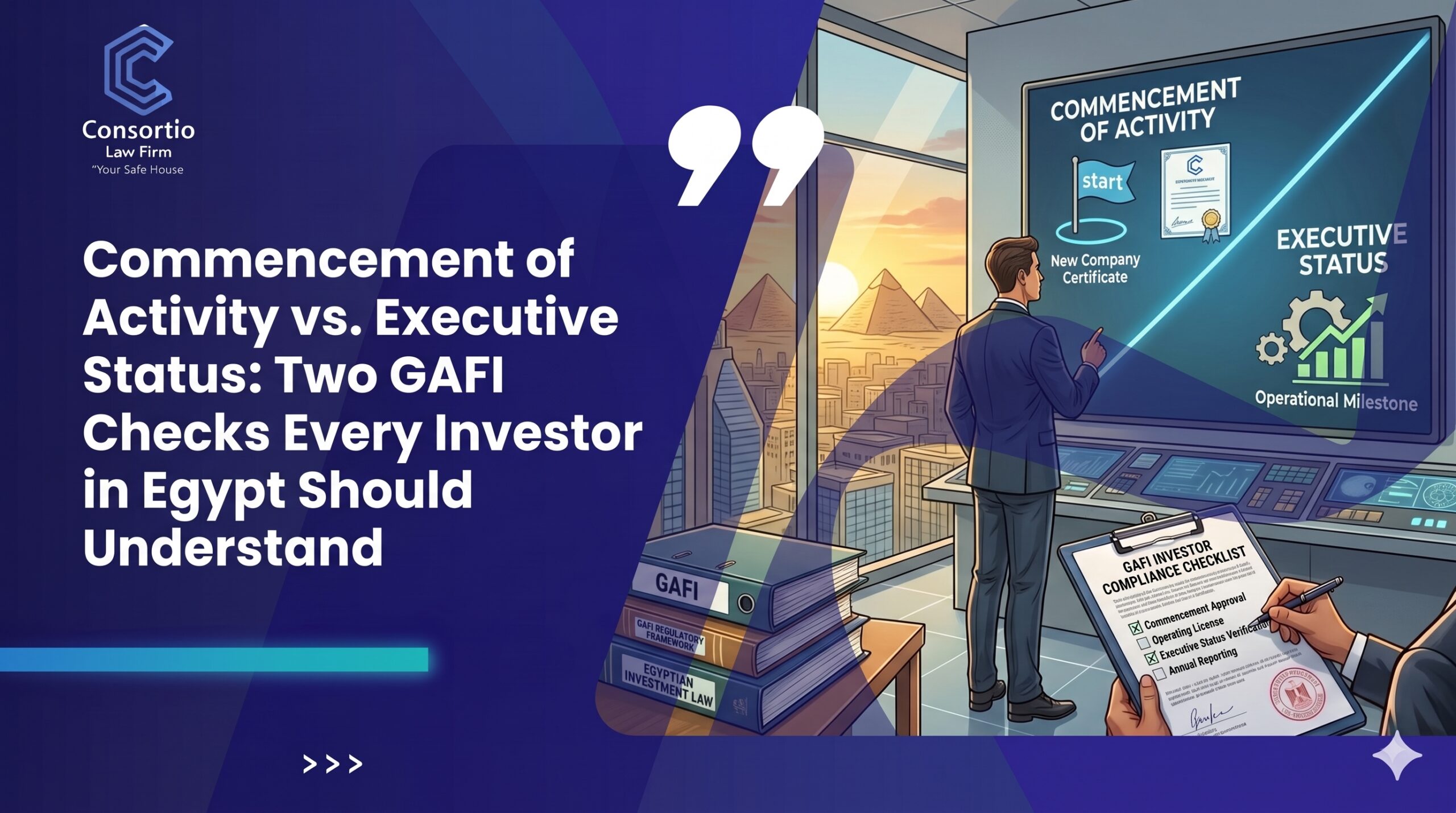
A foreign company can incorporate in Egypt, fund its capital in full, and still find its tax incentives stalled and its investors’ residence permits on hold — because the General Authority for Investment and Free Zones (GAFI) has not yet confirmed that the project is genuinely operating. Two separate committee procedures at GAFI’s Investor Service Center (ISC) govern that confirmation, and investors routinely treat them as one. They are not. They rest on different provisions, serve different purposes, and — importantly — demand different documents.
This article explains each one: where it comes from in the law, what it is for, and what you must actually submit.
The shared principle: the Investment Law rewards projects that operate, not shells
Both procedures flow from a single idea. The benefits of Law No. 72 of 2017 (the Investment Law) — its incentives and its investor guarantees — attach to real, operating projects, not to entities that exist only on paper. To police that line, GAFI is empowered to examine and follow up on projects. Two different benefits then trigger two different checks:
- a tax incentive, which needs a fixed start date; and
- an official recommendation (most visibly, residence for the investor and dependents), which needs proof of current operation.
That is the whole distinction in one sentence — a date for incentives, a status for recommendations. Everything below follows from it.
1. The Commencement-of-Activity Committee (for special incentives)
Where it comes from. Under the Investment Law’s special incentives (Article 11), a qualifying project may deduct 30% to 50% of its investment costs from its tax base — but only for a period not exceeding seven years, running from the date the project commences activity. Article 12 then sets the conditions: a newly established company, incorporated within the statutory window, keeping regular accounts, and not built on the assets of a pre-existing company. Because the seven-year clock starts on the commencement date, that date cannot be left to the company’s say-so — it has to be officially fixed.
In the ISC guide. GAFI’s Investor Service Center guide provides a dedicated service: forming a committee to determine the commencement date of activity or production for companies subject to Law 72/2017, and to consider their entitlement to the special incentives.
Its purpose. Two things at once: (i) pinpoint the exact date on which activity or production genuinely began — the moment the incentive period starts — and (ii) verify that the project actually qualifies for the special incentives under Articles 11 and 12.
What it requires. This is the heavy file, because proving a precise start date and incentive eligibility takes granular evidence. Among the key items: the incorporation decision and amendments; a recent commercial register extract and tax card; VAT registration; the site-possession deed in the company’s name; a machinery-and-equipment statement with purchase documents and customs-release forms; the building licence; a workforce statement with the social-insurance form; the notarized general journal and inventory books; the first and last batches of raw-material purchase invoices and of sales/revenue invoices (to bracket the start of activity); the electricity meter-installation minutes plus consumption bills from installation through commencement; an environmental statement on industrial wastewater and its treatment; the first two balance sheets with tax returns; an investment-cost statement certified by an auditor with a bank signature verification; and a declaration of the commencement date on GAFI’s prescribed form.
2. The Executive Status Determination (for genuine operation and recommendations)
Where it comes from. The Investment Law’s investor guarantees include residence for non-Egyptian investors throughout the term of the investment project — a guarantee that presupposes a project that is actually running. Paired with GAFI’s examination-and-follow-up authority, this means that before GAFI issues a recommendation which depends on the project being live — most commonly a residence recommendation for the investor or dependents — it first confirms the project’s executive status, i.e. that it genuinely operates.
This is the point that catches companies formed under the Companies Law (No. 159 of 1981): meeting the 159 capital requirement is necessary but not sufficient. Satisfying the paid-up capital threshold does not, on its own, produce a residence recommendation. GAFI still requires separate confirmation that the project is genuinely operating before it will issue that recommendation.
In the ISC guide. The guide provides an “Executive Status” determination service, and — tellingly — conditions residence(-renewal) recommendations on the company holding a certificate of commencement of activity, or the Executive-Status Committee’s report evidencing genuineness, where a year has passed since incorporation.
Its purpose. To confirm the project is genuinely up and running — real premises, real inputs, real revenue — so that GAFI’s downstream recommendations rest on a live project rather than a dormant registration.
What it requires. This is the lighter file. Among the key items: a company request and power of attorney; a recent commercial register extract and a valid tax card; a site-possession deed matching the activity actually carried on; the latest raw-material purchase invoice and the latest sales/revenue invoice; the prior year’s certified balance sheet (or a financial position); and the activity licences/approvals, or a declaration that they are being obtained. The committee may request any further documents the activity requires to prove genuineness, and the company has a three-month window to complete them.
So do the documents differ? Yes — in depth and purpose
The two files overlap on the core identity and premises documents — commercial register, tax card, VAT, site possession, licences, financial statements, and invoices. But they diverge sharply in how much and why:
| Commencement-of-Activity Committee | Executive Status Determination | |
|---|---|---|
| Legal anchor | Special incentives — Investment Law Arts 11 & 12 | Residence guarantee + GAFI examination/follow-up power |
| Goal | Fix the exact start date + confirm incentive eligibility | Confirm the project genuinely operates now |
| Invoices | First and last purchase and sales invoices (to bracket the start) | Latest purchase and sales invoice only |
| Utilities | Electricity meter-installation minutes + consumption history | Not required |
| Extra evidence | Machinery + customs release, building licence, environmental effluent, notarized books, auditor-certified investment cost | Prior-year balance sheet; current licences |
| Character | A full “operational data room” | A current-operations snapshot |
In short: the commencement-of-activity dossier is far heavier because it must establish a precise date and prove entitlement to a multi-year tax benefit; the executive-status dossier is lighter because it only has to show the project is operating today.
Why getting the distinction right matters
Treating these as one procedure costs time and money. Submit a light executive-status file when what you actually need is to lock in the incentive start date, and you risk pushing back the seven-year deduction window. Assume that your capital-compliant Companies Law 159 entity is automatically entitled to residence recommendations, and you overlook the separate genuine-operation test that GAFI applies before issuing them.
Handled in the right order — the commencement-of-activity committee to anchor incentives, the executive-status determination to unlock residence and other recommendations — both tracks keep moving, and neither the tax benefit nor the investor’s residence is left waiting on a file that was never going to be enough.
Consortio Law Firm advises international companies on establishing, operating, and dealing with GAFI throughout the life of an Egyptian project — including preparing the commencement-of-activity and executive-status files, securing investment incentives, and obtaining investor and dependent residence. Talk to our team about your project.
This article is general legal information, not legal advice; the Arabic text of the relevant laws, regulations, and official guides is the controlling source. For the authority itself, see the General Authority for Investment and Free Zones.