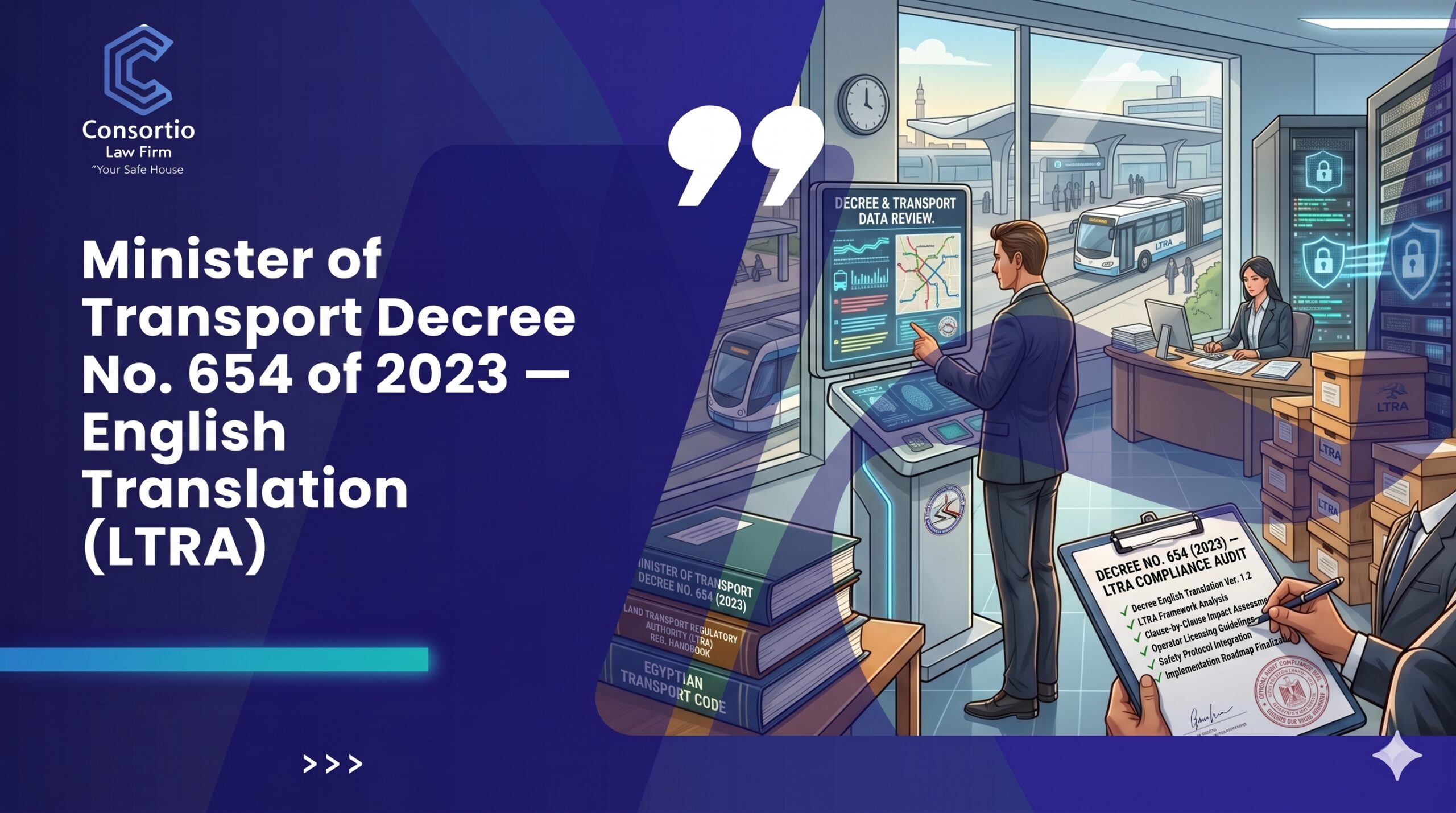
Issuing the Regulation Governing the Practice of the Activity of Land Transport of Goods, and the Activity of Freight Intermediation, Using Information Technology.
Published in Al-Waqāʾiʿ al-Miṣriyya, Issue No. 8 (annex), on 10 January 2024 · In force as of 11 January 2024.
Minister of Transport — Lt. Gen. Kamel El-Wazir.
Preamble
The Minister of Transport, after reviewing the Constitution; and Law No. 84 of 1968 on public roads; and Law No. 64 of 1970 regulating the transport of goods on public roads; and Law No. 22 of 1971 regulating the public transport of passengers by cars; and Law No. 53 of 1973 on the State’s general budget; and the Traffic Law issued by Law No. 66 of 1973; and the Law on the system for granting concessions to manage public transport-by-car facilities issued by Law No. 55 of 1975; and the Law establishing the Land Transport Regulatory Authority (internal and international) issued by Law No. 73 of 2019; and Presidential Decree No. 57 of 2002 organising the Ministry of Transport; and Minister of Transport Decree No. 90 of 2021 issuing the executive regulation of the Law establishing the Authority issued by Law No. 73 of 2019; and upon the approval of the Board of Directors of the Authority at its session No. (9) held on 10 September 2023; has decreed:
Issuance Articles
Issuance Article 1. The provisions of the Regulation accompanying this Decree shall apply with respect to the issuance of licences to practise the activity of land transport of goods, and the activity of freight intermediation, using information technology.
Issuance Article 2. This Decree shall be published in Al-Waqāʾiʿ al-Miṣriyya and shall come into force from the day following the date of its publication.
The Regulation — Part One: Definitions and General Provisions
Article 1 — Definitions
In applying the provisions of this Regulation, the following words and expressions shall have the meanings assigned to each of them:
- The Law: the Law establishing the Land Transport Regulatory Authority (internal and international) issued by Law No. 73 of 2019.
- The Authority: the Land Transport Regulatory Authority (internal and international) [LTRA].
- The Regulation: the Regulation governing the practice of the activity of land transport of goods using information technology, and the activity of freight intermediation using information technology.
- Activity of land transport of goods using information technology: performing the service of land transport of goods by any land transport means for consideration, using a platform, an application, an electronic website, or any electronic means, to conclude the transport contract.
- Activity of freight intermediation using information technology: carrying out the arrangements of transport operations with the carrier to move the goods from a consignor to a consignee for consideration, using a platform, an application, an electronic website, or any electronic means, to conclude the transport contract.
- The Consignor (Shipper): the natural or legal person contracting with the carrier directly, or with the freight intermediary using information technology, to transport the goods — whether the owner of the goods or authorised on their behalf — and who does not own land transport means.
- The Carrier: the natural or legal person holding a licence from the Authority to practise the activity of land transport of goods using information technology to the consignee, by land transport means owned by them and/or leased.
- The Freight Intermediary: the natural or legal person licensed by the Authority who contracts with the carrier in their own name for the account of the consignor to transport the goods to the consignee, and who does not own land transport means.
- Land transport means (means of carriage): the land transport means prepared and equipped to transport goods.
- The transport contract: a paper or electronic agreement concluded between the consignor (the owner of the goods or their representative) or the freight intermediary and the carrier, whereby the carrier undertakes to transport the goods from one place to another for consideration.
- The transport document: a paper or electronic document issued pursuant to the transport contract, which constitutes proof of the carrier’s receipt of the goods subject to transport in the condition stated therein, for delivery to the consignee in the same condition.
- The Authority’s electronic platform (LTRA platform): an electronic platform that enables the provision of certain land-transport services and activities to concerned persons, and enables the Authority to automatically track the locations of land transport means, determine their speeds, monitor the driver’s driving and rest periods, and verify the legality of the transport means and the driver.
- The carriers’ registration record: a paper or electronic record established at the Authority for the purpose of registering carriers, agents and intermediaries licensed to practise all land-transport activities, and registering and classifying all land transport means.
- Activity of leasing land transport means: leasing land transport means, with or without a driver, under a lease contract for consideration.
- The Lessor: the company holding a licence from the Authority to practise the activity of leasing land transport means.
- The Lessee: the natural or legal person benefiting from the activity of leasing land transport means.
- The lease contract: the contract concluded between the lessor and the lessee which defines the scope of the benefit and the obligations and rights between the parties to the lease contract.
- The head office: the premises through which the natural or legal person licensed to practise the activity of land transport of goods, or the activity of freight intermediation, using information technology, carries on that activity.
- Hazardous materials: any simple, compound, or mixed material, or any waste thereof, whether natural or manufactured, that poses a danger to the environment or to any of its elements, or to the safety of living beings, by reason of its toxicity or its capacity to ignite, explode, corrode, or transmit infection, and materials classified as hazardous under the provisions of international conventions.
- Non-standard loads: a load whose weight and/or dimensions exceed the prescribed weights and dimensions, such that the transported material cannot be divided or dismantled for any reason, and requires special land transport means for its carriage.
- Electronic transactions: any exchange, correspondence, or other procedure carried out wholly or partially by electronic means, including the storage of information and taking the necessary steps to facilitate access to and subsequent retrieval of the data.
- Judicial-officer inspector: the person legally authorised to inspect and supervise in order to verify compliance with the provisions of this Regulation.
- The financial consideration: the consideration for issuing approvals, licences, permits, operating cards, or any other services provided by the Authority.
Article 2 — Scope of application and the activities covered
Without prejudice to the provisions of Law No. 66 of 1973 issuing the Traffic Law and its amendments and executive regulation, the related laws and decrees, and the provisions of the international conventions to which the Arab Republic of Egypt is a party, the provisions of this Regulation shall apply to the companies and individuals working in the field of land transport of goods, and to freight intermediaries for the land transport of goods using information technology, who are subject to the provisions of the Law establishing the Land Transport Regulatory Authority (internal and international) issued by Law No. 73 of 2019 and its executive regulation, including — by way of example and not limitation:
- The activity of managing electronic marketplaces for freight services using information technology.
- The activity of providing shared (collaborative) freight services.
- The activity of delivering orders by means of transport.
- Any other transport activities in which information technology is used and which the Authority sees fit to add, or which are introduced in the future.
A coordinating negotiation minute shall be prepared between the Authority and the companies wishing to obtain the licence to practise the activity, setting the financial and technical controls and the other conditions according to the nature of each activity separately; and the negotiation minute shall be approved by the Authority’s Board of Directors.
Part Two — Conditions of Licensing
Article 3
- The activity of land transport of goods using information technology, or the activity of freight intermediation using information technology, may not be practised except after obtaining the necessary licences from the Authority.
- Each of the parties to the transport operation (the consignor/shipper, the carrier, the freight intermediary, and the consignee) shall comply with the provisions of Law No. 17 of 1999 issuing the Commercial Law.
Article 4 — Conditions for the carrier’s licence
For the carrier to obtain a licence to practise the activity of land transport of goods using information technology, an application shall be submitted through the Authority’s approved channels and the following requirements shall be satisfied:
- (a) A copy of a valid commercial register. (b) A copy of the tax card. (c) A technical system (a platform, an application, or an electronic website). (d) The appointment of a responsible or authorised person to communicate with the Authority, and the determination of the means of communicating with them.
- Preparing suitable premises or a head office appropriate for practising the activity.
- A detailed statement of the data and numbers of the land transport means participating in the technical system, whether owned or leased, used to practise the activity, certified and stamped with the company’s seal.
- A copy of the contracts concluded between the carrier and the owners of the leased transport means used in practising the activity.
- The licence shall be issued for a period of one year and up to a maximum of three years after payment of the financial consideration in the company’s name, in accordance with the provisions of the decision of H.E. the Prime Minister No. 4237 of 2022.
Article 5 — Contractual conditions
The holder of a licence to practise the activity of land transport of goods using information technology shall observe the following contractual conditions:
- Restricting the contracting for the provision of the service to the companies/individuals licensed by the Authority to practise land-transport-of-goods activities only, and for a period not exceeding the validity period of the licence granted to both parties, observing the following: (a) the availability of a valid operating card issued by the Authority for each transport means used in the activity; (b) that the driver of the land transport means holds a valid driving licence; (c) determining the mechanism for collecting the transport fees; (d) determining the policy of the service-provision fees.
- Determining the responsibilities and obligations relating to the parties to the transport operation upon contracting with them, in a manner that does not contravene the provisions of this Regulation.
- Prohibition of providing the service to foreign land transport means.
Article 6 — Operational conditions
The holder of a licence to practise the activity of land transport of goods using information technology shall observe the following operational conditions:
- Compliance with all laws in force in the Arab Republic of Egypt.
- Compliance with the regulations and instructions issued by the competent authorities in the event of using electronic payment.
- Continuity of the connection to the Authority’s electronic platform (LTRA platform), or to any other electronic systems determined by the Authority, throughout the validity period of the licence.
- Feeding the Authority’s electronic platform with the required data in real time, in particular the data of the driver, the vehicle, the trip route, the number and image of the transport document, and the evaluation results.
- Stopping the service to transport vehicles bearing cancelled or suspended operating cards.
- Not providing the service for the transport of hazardous materials.
- Not providing the service for the transport of non-standard loads.
- Displaying the trip route to the consignor/shipper and the consignee throughout the trip.
- Enabling the consignor/shipper and the consignee to evaluate.
- Displaying the evaluation results to the consignor/shipper and the consignee before obtaining the service.
- Emphasising to the carrier the necessity of issuing the transport document and the load statement.
- Providing the means of communication necessary for complaints, enquiries and reports.
- Updating the communication-means data at the Authority in the event of their change.
- Providing a secure system to protect the data of the parties to the transport operation from viruses and espionage.
- Reviewing with the Authority within ten (10) days from the date of the summons by the Authority.
- Providing the Authority with the data and information related to the activity that it requests, within a period not exceeding three business days from the time of the request.
- Enabling the judicial-officer inspectors to inspect the company’s records and to provide them with the information or documents related to the activity upon request.
Article 7
- The carrier or the freight intermediary shall prepare the transport document based on the data provided to them by the consignor regarding the details of the goods to be transported, and the conditions set out in the transport contract.
- In the event of doubt as to the accuracy of the data of the goods provided by the consignor, and where the carrier does not possess reasonable and applicable means to dispel that doubt, the carrier may add to the document a reservation specifying the inaccuracy and the reason for the doubt.
- Where the matter requires the carrier to examine the goods upon receipt in the presence of the consignor or their representative, to verify their contents, and this requires opening the packaging or containers, the carrier must restore the packaging and containers to their prior condition; and the carrier may charge the consignor or the consignee the value of what they spent, as the case may be, according to prevailing costs, with proof thereof recorded in the transport document.
- The carrier may refrain from transport if the examination of the goods reveals that their condition does not permit their carriage without some harm, and the consignor has not acknowledged in writing their knowledge of the condition of the goods and their acceptance of the responsibility for the possibility of harm occurring, with such acknowledgement recorded on the transport document.
- The carrier’s signature on the document without any reservation or the addition of any remarks shall be deemed an acknowledgement by the carrier of the correctness of everything stated in the transport document regarding the goods to be transported.
- The transport document shall constitute legal proof of the transfer of responsibility for the goods to the carrier in accordance with what is stated therein as to type, quantity, number and weight, where there were no reservations from the carrier.
- The carrier shall be responsible for performing the transport contract in accordance with the provisions and conditions set out therein, whether the transport was carried out by the carrier or its execution was assigned wholly or partially to another person acting in the carrier’s stead.
- The carrier shall transport the goods by land transport means suitable to the nature of the goods and in accordance with the conditions and specifications determined under the applicable legislation.
- The carrier’s responsibility begins upon its receipt of the goods at the agreed place, and ends upon their delivery to the consignee; the carrier’s keeping of the goods in its warehouses for the purposes of transport shall be deemed an act complementary to the transport contract.
- The carrier shall follow the agreed route for transporting the goods as specified in the transport document; if no specific route was agreed, the carrier shall follow the shortest customary route for transport.
- The carrier licensed to practise the activity of land transport of goods using information technology shall be responsible for delay in receiving and delivering the goods, and for their loss or partial or total damage arising from a technical fault in the service-provision system.
Article 8 — Conditions for the freight intermediary’s licence
For the freight intermediary to obtain a licence to practise the activity of freight intermediation for goods using information technology, an application shall be submitted through the Authority’s approved channels and the following requirements shall be satisfied:
- (a) An application submitted by the company (natural or legal person). (b) A copy of a valid commercial register that includes the activity. (c) A copy of the tax card. (d) A technical system (a platform, an application, or an electronic website). (e) Preparing premises or a head office for practising the activity. (f) Connection to any electronic systems determined by the Authority. (g) The appointment of a responsible or authorised person to communicate with the Authority, and the determination of the means of communicating with them.
- The licence shall be issued for a period of one year and up to a maximum of three years after payment of the financial consideration in the company’s name, in accordance with the provisions of the decision of H.E. the Prime Minister No. 4237 of 2022.
Article 9
- The freight intermediary undertakes (after verifying the name and address of the consignor) to conclude, in their own name and for the account of the consignor, a contract with the carrier for the transport of the goods for a determined fee, and to carry out all the procedures necessary for that purpose.
- The freight intermediary shall be responsible for the goods that are the subject of transport from the time of their receipt, and during their loading, unloading, transport, storage, and until their delivery to the consignor.
- The freight intermediary shall ensure that the carrier proceeds with the transport operation at the agreed time, without prejudice to the carrier’s responsibility under the provisions of this Regulation; the freight intermediary shall be responsible for the carrier’s non-performance of the contract or for the delay in performance, and the freight intermediary has the right of recourse in responsibility against the carrier with the consignor.
- The freight intermediary shall be responsible for the total or partial loss of the goods, and for their damage or delay in delivery, and may not negate this responsibility except by proving force majeure, an inherent defect in the goods, or the fault of the consignor, the consignee, or the carrier.
- Upon receiving the goods, the freight intermediary shall verify the accuracy of the data contained in the freight request, such as the number of containers and pieces, the quantities, the marks and the numbers, and the condition of the apparent goods, their packing and their wrapping.
- If the freight intermediary does not have the customary means for verification of the condition of the goods, they must record proof of their reservation together with a statement of the reasons for this reservation.
- The consignor has the right, at their own expense, to require the freight intermediary to verify the existing weight of the goods, or their quantity and contents, with the verification results recorded on the freight request.
- If the examination reveals that the condition of the goods does not permit their carriage without harm, the freight intermediary may do any of the following: (a) refuse to execute the freight after an acknowledgement from the consignor of their knowledge of the condition of the goods; (b) execute the freight — in which case the condition of the goods is recorded and the consignor’s acknowledgement on the freight request is obtained.
- The freight intermediary shall record in their books the type of goods, their amount, quantity, value and source, the transport date scheduled for them, and any information relating to them.
- The freight intermediary undertakes to take the measures necessary to verify the carrier’s competence to perform the rights of the consignor or the consignee, and to inform the consignor of any accident or difficulty that may occur during the carrier’s performance of the transport contract, including notifying them of the consignee’s refusal to receive the goods or their presence.
- The freight intermediary shall provide the carrier to whom the execution of the transport contract has been entrusted with all the information that assists in transporting the goods without harming them, for their delivery.
- The freight intermediary shall, based on the written request of the consignor, insure the goods against a commission that they charge, provided that the value of that insurance and the risks it covers are specified in the request; and the freight intermediary shall, for the account of the consignor, take all the procedures necessary to claim the compensation arising from the insurance contract and to follow up on the claims relating to it, provided this is done based on the written request of the consignor if they are the beneficiary of the insurance contract.
- Storage shall take place in the freight intermediary’s stores or in any other store, and the consignor or their representative has the right to inspect the store in which the freight intermediary will store the goods to verify the extent of its suitability to the nature of the goods.
- If the freight intermediary pays the transport fees to the carrier, they shall replace the carrier in respect of the rights the carrier has under the provisions of the transport contract.
Article 10
- The consignor shall be responsible for the damages and losses incurred by the carrier and by third parties as a result of the failure to complete the documents necessary to perform the transport contract, or their non-conformity with the facts, or the deficiency of the data they provide, or its inaccuracy.
- The consignor shall prepare the goods for transport by wrapping, packing or bundling them in a manner suitable to preserve them from perishing or damage, and in a manner that ensures the protection of persons, equipment, land transport means, and the other goods transported with them from any harm that may befall any of them.
- The consignor may request, at their own expense from the carrier, the verification of the existing weight of the goods or their quantity and the contents of the parcels, provided that the verification results are recorded in the transport document; and if the transport requires taking special arrangements, the consignor must notify the carrier thereof in writing in sufficient time before the goods are delivered to them.
- After delivering the goods, the consignor may request the carrier to stop the transport, and return the goods to them or direct them to a person other than the consignee, within the agreed conditions, so long as the goods remain in the carrier’s possession, or to a place other than the place agreed in the transport document or other instructions, provided that the consignor pays the fee for the transport carried out and what results in expenses, and compensation for any harm that befalls the carrier by reason of executing the new instructions.
Part Three — The License
Article 11 — Types of licence
First — companies that own land transport means used to practise the activity of land transport of goods using information technology (the carrier): they must obtain: (1) a licence to practise the activity of land transport of goods using information technology; (2) an operating card for each land transport means used to practise the activity.
Second — companies that lease land transport means used to practise the activity of land transport of goods using information technology (the freight intermediary): they must obtain: (1) a licence for freight intermediation for goods using information technology. And it must be verified that: an operating card is available for each land transport means, belonging to a company holding the necessary licences from the Authority.
Third — companies that own and lease land transport means used to practise the activity of land transport of goods using information technology (the carrier and the freight intermediary together): they must obtain: (1) a licence to practise the activity of land transport of goods using information technology; (2) a licence for freight intermediation for goods using information technology. And it must be verified that: an operating card is available for each land transport means, belonging to a company holding the necessary licences from the Authority.
Article 12
The conditions of the licence are necessary for its validity; and in the event of a grave breach of any of these conditions, the carrier/freight intermediary shall be notified of that breach, and the Authority has the right to suspend the licence should the licensee fail to observe the Authority’s remarks within a period of no more than sixty (60) days from the date of the notification.
Article 13
The licence shall be renewed at the request of the carrier/freight intermediary, after payment of the financial consideration for a similar period, provided that the renewal application is submitted and all its conditions satisfied within the sixty (60) days preceding the expiry of the validity period of the licence. The licensee shall not be permitted to practise the activity after the date of expiry of the licence.
Article 14
The licensee (the carrier/freight intermediary) may not assign the licence to others except with the approval of the Authority.
Article 15
- The licensed carrier/freight intermediary may apply for cancellation of the licence in accordance with the following controls: (a) cancellation of the activity from the commercial register; (b) payment of the financial consideration due to the Authority.
- The licence shall be void (null) in the following cases: (a) cancellation of the company’s commercial register; (b) contracting for the provision of the service with companies/individuals not licensed by the Authority to practise land-transport activities; (c) liquidation of the company, whether by agreement of the partners, by expiry of its term, or by a judicial ruling; (d) expiry of the licence without its renewal, with the Authority’s right to confiscate the security (guarantee); (e) assignment of the licence without the Authority’s prior approval; (f) the lapse of sixty (60) days of suspension of the licence without completing any of the conditions of validity of the licence.
Article 16 — The operating card
The operation of any transport means is prohibited unless the licensee (the carrier) has obtained an operating card according to the form prepared by the Authority. This card shall contain the following data:
- The name and emblem of the Authority.
- The name and address of the licensee.
- The plate number of the land transport means and the number of the licence to practise the activity.
- The type of the licensed activity.
- The load of the transport means and its type.
- Determination of the scope of transport (internal / international).
- The date of expiry of the licence to practise the activity.
- The date of issuance and expiry of the operating card.
- Any other data the Authority sees fit to add.
Article 17 — The transport document
The carrier or the freight intermediary must issue a paper or electronic transport document (internal and/or international) for each transport operation, according to the form and the issuance mechanism approved by the Authority; it shall be in the name of one consignee if it is non-negotiable, or to the order of, or to bearer, if it is negotiable, and shall provide the consignor with an original copy thereof and retain another copy in the transport means. The Authority shall collect a financial consideration for each transport document issued by the licensee; the financial consideration to the Authority shall be delivered accompanied by a copy of each document issued, provided that the number of original copies is not less than three copies. The document shall include the following data:
- The place, date and time of issuance of the document, and the number of original copies, and whether the document is negotiable or non-negotiable.
- The name of the consignor, their address and means of contacting them.
- The name of the freight intermediary, their address, means of contacting them, and their licence number.
- The name of the carrier, their address, means of contacting them, and their licence number.
- The name of the consignee, their address and means of contacting them, and the data of an alternative consignee if the matter so requires.
- The type of goods and their general nature, the marks necessary to identify them and their characteristics, and an express warning of the nature of the danger of the goods.
- The number of containers or pieces and the total weight, or the number of heads of animals, or the total weight, or the quantity transported of the goods.
- The total transport fee, and determining whether the transport fees are paid by the consignor or paid by the consignee, and any additional expenses and the party bearing them.
- The place, date and time of transfer of the goods to the responsibility of the carrier or the executing party; and if this is not specified in the document, reference may be made to the place, date and time of issuance of the document as the date for that.
- The place, date and period of delivery of the goods at the place of delivery, if the parties have agreed on this at the time of issuance of the document.
- The route of the trip for the transfer of the goods to their destination, if the matter so requires and the route was known at the time of issuance of the document.
- The signature of the carrier and the consignor, or the person authorised on their behalf.
- Any reservation of the carrier, the consignor or the consignee, with a statement of the reason.
- Any other data determined by the Authority, required by the transport operation, or required by the procedures of any other governmental body.
The omission of one or more items of the transport document’s data, or their inaccuracy, does not affect the legal character of the document or its validity.
Article 18 — Conditions of the driver
The driver of the land transport means, for practising the activity of land transport of goods using information technology, must satisfy the following:
- Holding a valid driving licence of the category appropriate to the type and size of the land transport means, in accordance with the Traffic Law and its executive regulation.
- That the criminal-record certificate be free of precedents.
- Passing the medical examination at one of the medical centres approved by the Authority to verify their non-use of narcotics and intoxicants.
- Passing the professional-competency test appropriate to the type of activity at one of the training centres approved by the Authority.
- Being fully aware of the use of the technological means and applications used before and during the transport operation.
Forms
Form No. 1 — Licence No. ( ) of the year 20… for practising the activity of land transport of goods using information technology (Companies). The Land Transport Regulatory Authority (internal and international) licenses the company … / joint-stock, in Cairo — Commercial Register No. …, Tax Card No. … Office … — to practise the activity of land transport of goods using information technology, in accordance with the provisions of Law No. 73 of 2019 and its executive regulation, and in accordance with the provisions, controls and conditions set out in the Regulation governing the land transport of goods using information technology, approved by the Board of Directors of the Authority. Registration and entry in the carriers’ record at the Authority took place on …/…/… under No. ( … ). The validity period of this licence is three years, beginning …/…/20… and ending …/…/20…, with renewal to be carried out by the Land Transport Regulatory Authority (internal and international).
Form No. 2 — Licence No. ( ) of the year 20… for practising the activity of freight intermediation for the land transport of goods using information technology (Companies). [Same structure as Form No. 1, for the freight-intermediation activity.]
End of the working translation of Minister of Transport Decree No. 654 of 2023. Prepared by Consortio Law Firm — “Your Safe House.” The Arabic published text governs.