Building a factory in Egypt is a major commitment — but pouring the foundations is not the same as being allowed to operate. A foreign manufacturer can install its machinery, hire its workforce, and still be running an illegal plant if it holds the wrong authorization. That is because an industrial license in Egypt is not a single document. It is a regime, and the system your factory falls under is decided by law, not by preference.
This guide explains the two licensing systems that govern industrial activity in Egypt, how to tell which one applies to your project, and what is at stake if you get the classification wrong.
The rule before you operate
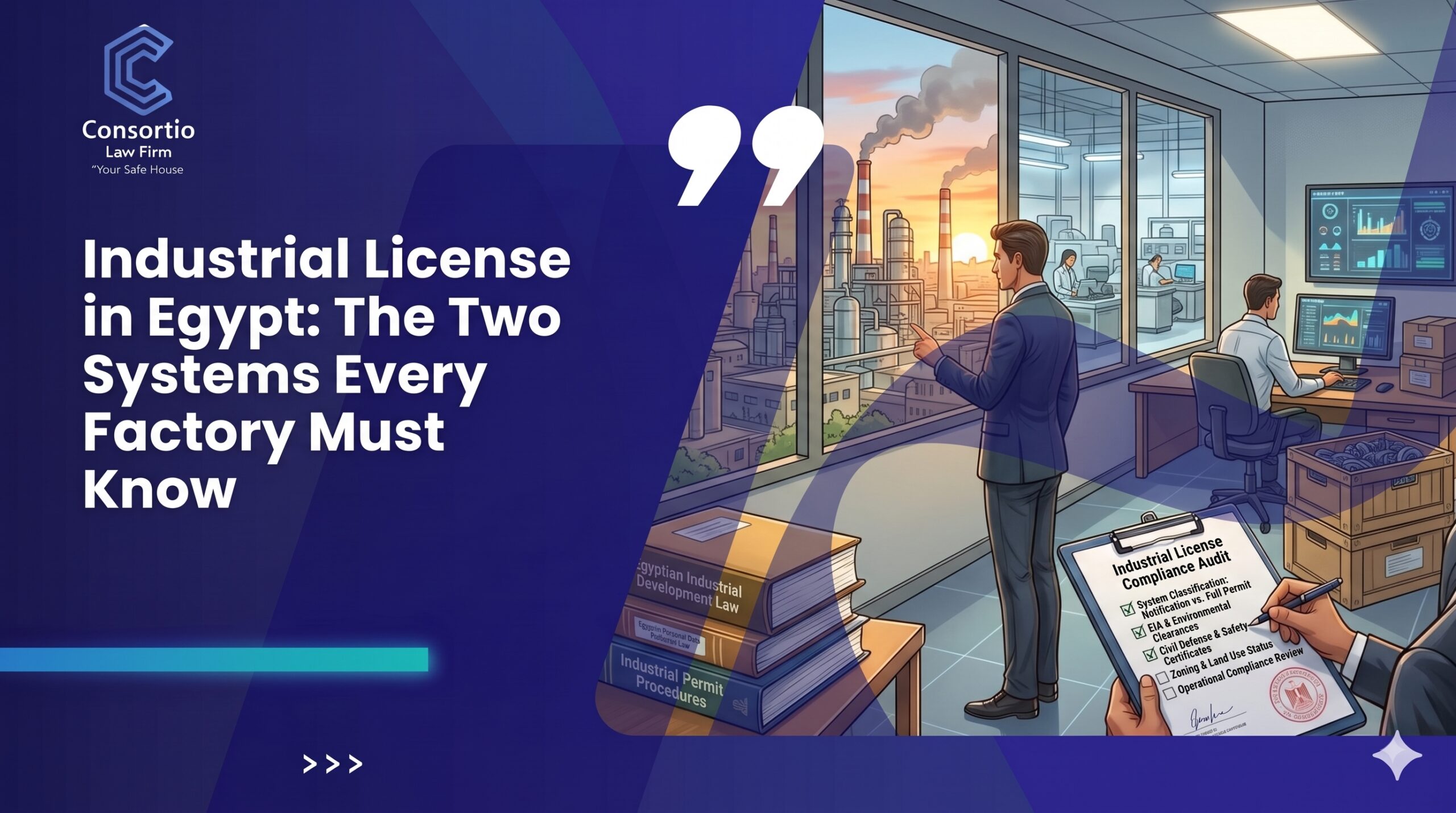
The foundation is Law No. 15 of 2017, the Industrial Establishment Licensing Facilitation Law, administered by the General Authority for Industrial Development (IDA). Article 2 is blunt: no one may establish, manage, operate, expand, change the industrial purpose of, or relocate an industrial establishment without a license issued under the law. Just as importantly, the same article states that no other authority’s approval can substitute for it.
For international investors, that last point matters. Securing an environmental clearance, a building permit, or an investment approval does not, on its own, make your factory lawful to run. The industrial license sits on top of everything else — and the law deliberately folds the fire-safety, environmental, industrial-security and occupational-health conditions into that single license.
The two types of industrial license in Egypt
Law 15/2017 creates two distinct routes to a license. Which one applies depends entirely on how risky your activity is — not on the size of your plant or the nationality of its owner.
1. The notification system (lower-risk activities)
For activities that do not pose a high degree of risk, the law uses a light-touch notification system. Here, the process is inverted from what many investors expect. You submit a notification on the official form, and once the authority stamps your copy, that notification itself operates as a license of unlimited duration. In other words, you may begin operating immediately.
The authority then carries out an inspection within 90 days. If your plant falls short of any condition, you receive a grace period to bring it into line rather than an immediate shutdown. The logic is simple: operate first, and the state verifies afterwards.
2. The prior-license system (higher-risk activities)
For activities that carry a significant risk to security, health, safety or the environment, the law requires the opposite approach. Under the prior-license system, you must obtain approval before you establish, manage or operate the plant. As a result, you cannot switch on the production line until the license issues.
The authority reviews your application, verifies the conditions, and must decide within 30 days of a complete file. Where only minor, non-essential conditions are missing, it can grant a temporary license for one year — renewable up to three years — while you finish the work. Here the logic reverses: verify first, then operate.
How to know which system applies to your factory
The dividing line is not left to interpretation. The executive regulation of the law — Ministerial Decree 1082/2017 — carries an annexed schedule that lists the high-risk activities by their international ISIC4 classification code. The system that governs your industrial license in Egypt is therefore decided mechanically:
- If your activity appears on the schedule, you are in the prior-license system.
- If your activity is not on the schedule, you fall under the notification system.
The schedule captures the sectors you would expect: cement, iron and steel, base chemicals, fertilizers, pharmaceuticals, glass, tanning, pulp and paper, distilling and brewing, tobacco, explosives, motor vehicles, and large-scale fuel and chemical storage, among others. A useful first step for any manufacturer is therefore to match its activity to an ISIC4 code and check it against that list.
There is one important relief. An activity that would normally require a prior license can be handled under the notification system if it is carried out inside a properly planned industrial zone — one where the security, health, safety and environmental conditions were built in from the start. For an investor choosing between a greenfield plot and an established industrial zone, that distinction can meaningfully shorten the path to production.
The heavy-industry tier
Above the prior-license system sits a further layer for a defined group of heavy industries. Under Article 36 of the law and Cabinet Decree 47/2020, licenses for activities such as cement, iron and steel, tobacco, and spirits are not simply applied for — they are offered competitively. The state decides how many licenses to release and where, then allocates them through an auction or tender to investors who qualify technically and financially, against a set fee. A company entering one of these sectors is therefore competing for a limited number of licenses, not filing a routine application.
Practical takeaways for foreign manufacturers
For international companies establishing or expanding in Egypt, a few points repay early attention. Securing the right industrial license in Egypt at the outset is far cheaper than unwinding an unlawful operation later.
- Classify first. Identify your ISIC4 code and confirm whether it sits on the prior-license schedule before you commit to a site or a timeline.
- Treat growth as a new license. An expansion, a change of product, or a relocation each re-trigger the licensing process — and can move you from the light regime into the heavy one.
- Mind the renewal. A license that is not renewed within two months of expiry can be revoked.
- Know where the conditions live. The detailed technical conditions are published by the authority in its Industrial Activity Practice Guide and are updated over time, so compliance is an ongoing exercise rather than a one-off.
The choice of system, the conditions attached, and the sequence of approvals all shape how quickly — and how safely — a foreign manufacturer can begin production. And it all starts with the right industrial license in Egypt.
Consortio Law Firm advises international manufacturers and investors on establishing, licensing and operating industrial projects in Egypt — from classifying your activity and securing the right license to maintaining inspection-ready compliance. Talk to our team about your project.
This article is general legal information, not legal advice; the Arabic text of the relevant laws is the controlling source. For the licensing authority, see the Industrial Development Authority.