By Karim El Sayed, Managing Partner, Consortio Law Firm. Last reviewed November 2026.
The short answer
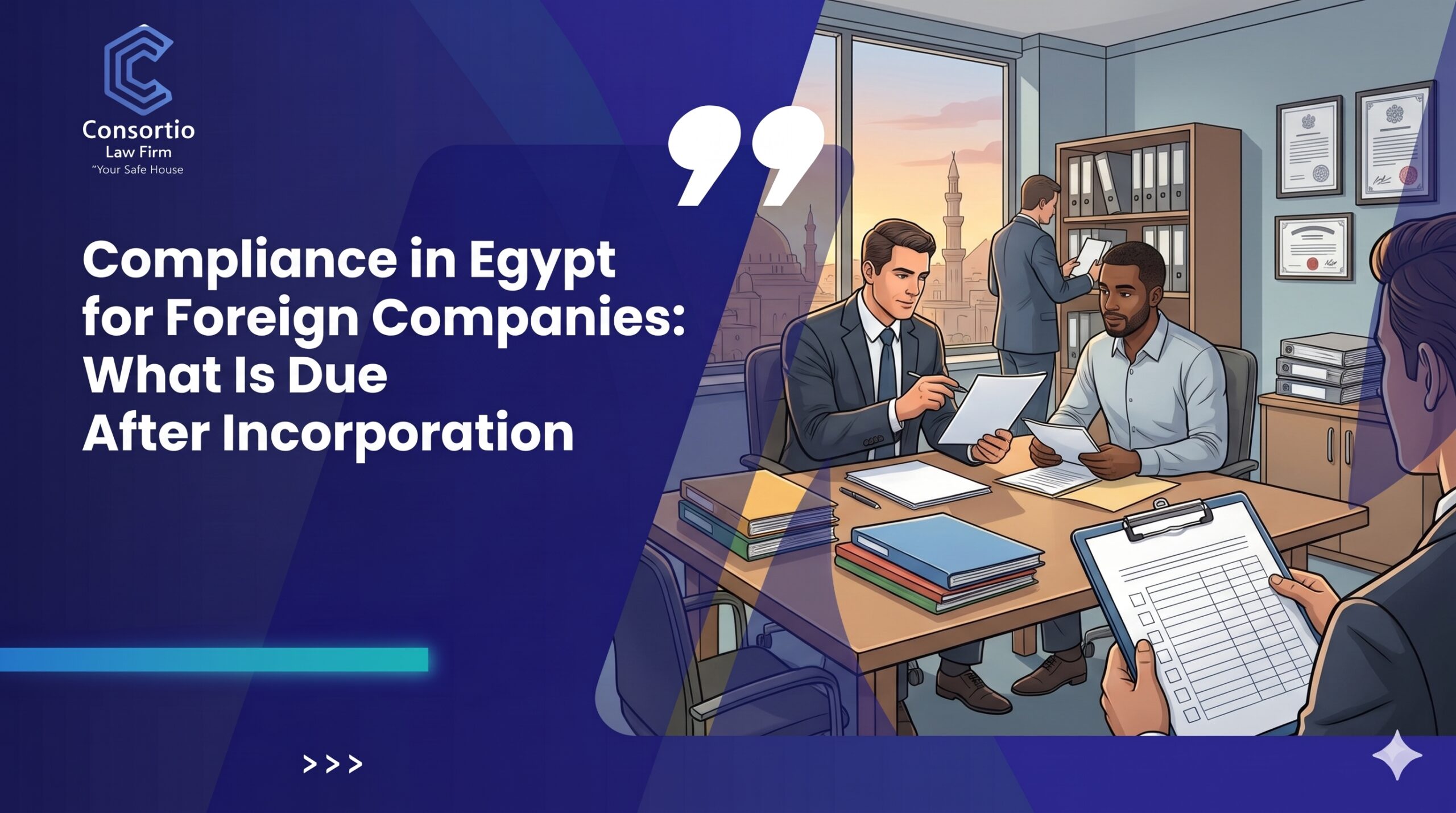
Registration starts the clock; it does not finish the job. Once a foreign-owned company is on the Egyptian commercial register, obligations begin to run before separate authorities: the bank, the tax authority, social insurance, the labour office, GAFI and, depending on the activity, a sector regulator. None of them sends a reminder.
This guide sets out what is due, in the order it falls due, and links to our detailed article on each point. If you have not incorporated yet, start with our company formation guide.
The first 90 days: what to put in place
| Step | What it involves | Why it cannot wait | Read more |
|---|---|---|---|
| Corporate bank account | The bank’s KYC file: corporate documents, beneficial-owner and source-of-funds declarations, board resolutions and signature specimens | The bank’s review is the step that most often costs a foreign investor its first quarter | The realities of opening a corporate bank account |
| VAT registration | The activity decides the rule. Some activities, consultancy being the best-known example, must register from day one with no threshold. For the others, VAT applies once sales reach EGP 500,000 | A company that should have registered from day one is exposed from its first invoice | The threshold trap and the 30-day clock |
| E-invoicing | Enrolment on the Egyptian Tax Authority’s e-invoicing platform | Without it the company cannot issue an invoice at all, so it cannot collect its revenue, let alone recover VAT | No e-invoice, no deduction |
| Social insurance | Opening the employer file within two weeks of starting activity and enrolling employees from their first day | The obligation runs from the first day of employment, not from the first inspection | Social insurance registration for corporate employers |
| Employment documents | Arabic and English employment contracts and internal regulations under Labour Law No. 14 of 2025, with the labour office filings | Contracts and filings are what an inspector, or a former employee’s lawyer, asks for first | The five obligations most foreign companies miss |
| Trademark | Filing the company’s mark in Egypt | Protection is territorial: a registration abroad does not protect the mark here | The five obligations most foreign companies miss |
| GAFI status | Confirming commencement of activity and the company’s executive status | The commencement date starts the period for investment-law tax incentives, and executive status is checked before GAFI recommends residence for the investor | Two GAFI checks every investor should understand |
The obligations that recur
Corporate. Every year the company holds its general meeting and files its financial statements; see annual corporate compliance. Changes to managers, capital or the statute are recorded with GAFI, and beneficial-owner information is kept up to date. If the company makes losses, the board or the partners must act at set thresholds; see company losses in Egypt.
Tax. Corporate income tax, VAT returns, payroll tax, and withholding tax on payments to local and foreign suppliers each run on their own calendar. E-invoicing applies to every invoice the company issues.
Labour and social insurance. Contributions are paid and records kept every month, and each hire, change and exit has its own deadline; see social insurance beyond registration and deadlines for employee changes. Foreign staff need work permits from the start. Where the employee is already in Egypt, an exemption from the recruitment-from-abroad requirement can be requested, and national projects or projects that involve state work may qualify for further exemptions; see foreign employee work permits.
The activity itself. The company may only do what its registered activity covers, and many activities carry their own licences, inspections and reporting. For factories, see industrial compliance in Egypt.
Personal data. A company that processes personal data in Egypt falls under the Personal Data Protection Law; see the local representative requirement.
What goes wrong when compliance is left to chance
Compliance failure in Egypt is rarely dramatic. It accumulates. The obligations that cause the most damage carry no immediate penalty, so they stay invisible until the company needs something: an audit closes, a bank reviews the account, a licence comes up for renewal, or a former employee files a claim.
Most foreign investors meet these obligations the expensive way: a routine inspection, a supplier invoice that cannot be deducted, or a trademark claim from a local opportunist. We set out the five we see missed most often in The Five Egyptian Compliance Obligations Most Foreign Companies Miss in Year One.
How we handle it: two packages and a managed service
The foundational package covers what every company in Egypt owes, whatever its activity. It is a single, finite engagement with no recurring fees:
- Corporate bank account: choice of bank, the full KYC file, and liaison with the bank’s compliance team until the account is active.
- Social insurance: opening the employer file and enrolling the first employees.
- Trademark: availability search and filing of one mark in one class.
- E-invoicing: registration on the tax authority’s platform through a partner auditor, under our supervision.
- Labour documents: a bilingual employment contract and internal regulations under Labour Law No. 14 of 2025.
- A written labour compliance checklist for the company’s headcount.
The activity-specific package maps the obligations that follow from what the company actually does:
- Every law, regulation and decree that governs the licensed activity, in one reference document.
- An item-by-item checklist of recurring obligations: licensing, reporting, inspections, sector tax treatment, customs and import controls where relevant.
- The regulator’s forms, with guidance on completing them.
- The obligations whose breach carries criminal exposure, loss of licence or a material penalty, flagged separately.
- A working session with your operations team, so the framework is in use from day one.
The two packages can be taken together or separately. Companies that want compliance run for them every month use our managed compliance service.
Questions foreign companies ask us
When do compliance obligations start? On registration. Several of them, such as social insurance and e-invoicing, are triggered by the first employee or the first invoice, not by a date in the calendar.
Do we have to register for VAT straight away? It depends on the activity. Some activities, consultancy being the best-known example, must register from day one with no threshold. For the others, VAT applies once sales reach EGP 500,000.
Can we invoice customers before we are on the e-invoicing system? No. Without e-invoicing the company cannot issue an invoice at all, which means it cannot collect its revenue.
When must we register for social insurance? Within two weeks of starting activity. Each employee is enrolled from the first day of employment.
Our trademark is registered at home. Do we need to file in Egypt? Yes. Trademark protection is territorial, and the first year is the right time to file.
Can the company take on work outside its registered activity? No. The activity in the commercial register defines what the company may do. Amend it before the new work starts, not after.
Is opening the bank account a compliance matter? Yes. The bank reviews the ownership chain, the beneficial owners and the source of funds, and it asks again when the company’s details change.
Do we need a monthly retainer to stay compliant? No. The two packages are one-time engagements. A monthly managed service is available for companies that want the filings run for them.
Legal basis
The main texts are the Companies Law No. 159 of 1981, the Labour Law No. 14 of 2025, the VAT Law No. 67 of 2016 and the Personal Data Protection Law No. 151 of 2020, together with the social insurance and income tax legislation and the rules of the sector regulator for each activity. English translations of the Companies Law, the Labour Law and the VAT Law are available on this site. The Arabic texts control.
Close the gap in the first ninety days
The first ninety days decide how the company stands with its bank, the tax authority and the labour office for years afterwards. Tell us your activity and your headcount, and we will tell you what is already due. Book a compliance review.