Foreign companies entering Egypt—whether from the GCC, Europe, Africa, or Asia—quickly discover that the Egyptian compliance system is detailed, structured, and highly procedural. Unlike jurisdictions that offer flexible or light regulatory burdens, Egypt requires companies to follow strict annual, quarterly, and transactional requirements to remain compliant.
This concerns many foreign headquarters, who often ask:
-
“What are our tax obligations in Egypt?”
-
“What must we file with GAFI every year?”
-
“Do we need to disclose ultimate beneficial owners (UBO)?”
-
“What are the residency rules for foreign managers and shareholders?”
-
“What happens if we miss a filing or make a mistake?”
-
“Can these compliance issues expose us to liability abroad?”
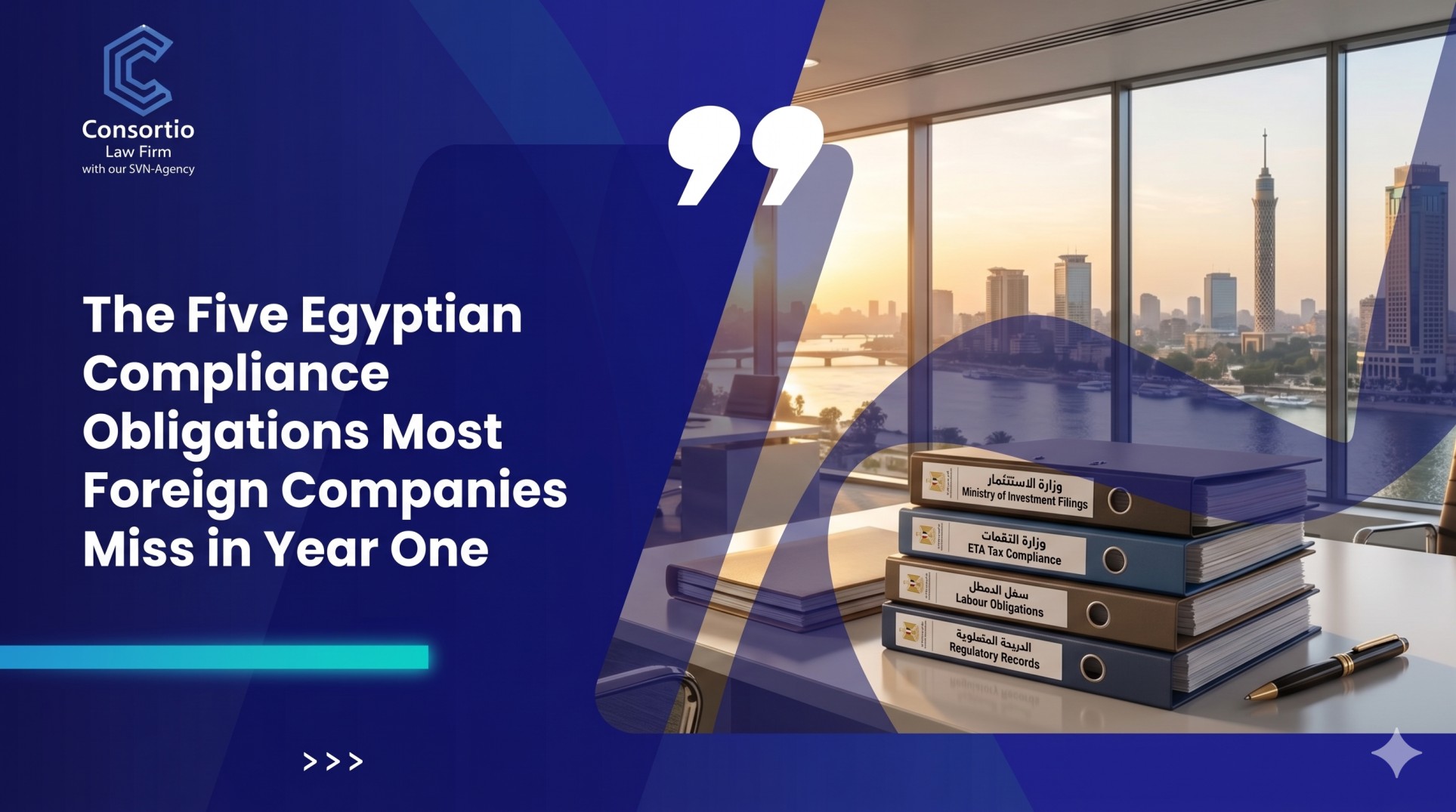
This article provides a complete, structured guide for foreign companies operating in Egypt, explaining the compliance obligations that matter most—tax, GAFI filings, UBO disclosure, residency rules, and ongoing regulatory duties.
1. Understanding Egypt’s Compliance Environment: Why Foreign Companies Feel the Pressure
Egypt’s compliance system is built on four pillars:
-
Corporate filings with GAFI (General Authority for Investment)
-
Tax and VAT compliance with the Egyptian Tax Authority
-
UBO disclosure and anti–money laundering requirements
-
Residency rules for foreign managers and shareholders
Foreign companies often underestimate how strict these obligations are.
In Egypt:
-
Missing filings leads to administrative penalties
-
Tax compliance is monitored monthly
-
UBO disclosure is mandatory
-
Work Permits and residency have specific quotas
-
Bank compliance requires clarity on structure and ownership
-
Authorities cooperate closely on data exchange
For foreign investors, this creates a risk landscape that must be understood and managed professionally.
2. Tax Compliance in Egypt: What Foreign Companies Must Know
Tax compliance is the most sensitive area for foreign companies.
Egypt requires multiple layers of tax reporting and filings, including:
A. Corporate Income Tax
Companies must:
-
Register a tax card immediately after Incorporation
-
File annual tax returns
-
Maintain proper Egyptian GAAP accounting records
-
Pay corporate tax on profits generated in Egypt
-
Maintain audited financial statements
Foreign companies often misunderstand this point:
If you operate in Egypt, you are taxed in Egypt — even if HQ is abroad.
Whether the company has profit or not, filings must still be done.
B. VAT Registration and Monthly Declarations
VAT compliance requires:
-
Registration once activity qualifies
-
Issuing VAT-compliant invoices
-
Collecting VAT from customers
-
Filing monthly VAT returns
-
Maintaining all invoice and payment records
-
Ensuring the correct VAT rate for your activity
The monthly filing requirement is strict; delays trigger penalties immediately.
C. Withholding Tax
Many transactions in Egypt are subject to withholding tax, including:
-
service fees,
-
rental contracts,
-
consulting fees,
-
subcontracting,
-
commission arrangements.
Foreign companies must understand which payments trigger withholding and how to structure them.
D. Payroll Tax
If the company hires employees, payroll tax and Employment Law become mandatory.
The Most Common Tax Pitfalls Foreign Companies Face
-
Not filing on time
-
Incorrect VAT treatment for services vs. goods
-
Not maintaining proper accounting books
-
Assuming exemptions apply automatically
-
Using contracts that violate Egyptian tax rules
-
Incorrect treatment of cross-border service payments
Consortio’s tax compliance service providers network prevents these issues by implementing a structured reporting system.
3. GAFI Filings: The Corporate Obligations Foreign Companies Often Miss
Foreign companies operating as LLCs or Branches must comply with annual GAFI filings, including:
1. Annual general meeting documentation
Resolutions approving:
-
financial statements,
-
auditor appointment,
-
profit distribution,
-
board actions,
-
corporate governance matters.
2. Filing audited financial statements
Companies must file approved and audited financials annually.
3. Updating corporate records
Any changes in:
-
shareholders,
-
managers,
-
powers of attorney,
-
addresses,
-
activity,
-
capital,
-
governance
…must be filed with GAFI and updated in the Commercial Registry.
Foreign companies often mistakenly assume that simple internal decisions are sufficient.
In Egypt:
Nothing is effective until it is filed, stamped, and registered.
4. Filing requirements for branches
Branches must additionally file:
-
contract renewals,
-
project updates,
-
revenue reports.
Failure to file correctly can result in suspension or penalties.
4. UBO Disclosure: Egypt’s Ultimate Beneficial Owner Requirements
Egypt requires all companies to maintain full transparency over their ownership chain.
This includes disclosure of:
-
ultimate beneficial owners (natural persons),
-
ownership percentages,
-
control structures,
-
foreign parents and holding companies,
-
signatory authority.
This information is required for:
-
GAFI
-
banks
-
tax authority
-
licensing bodies
-
anti–money laundering units
Foreign companies often ask:
“Can we avoid disclosing certain owners for privacy reasons?”
The answer is no.
UBO disclosure is mandatory for:
-
Incorporation
-
banking
-
licensing
-
tax compliance
Failure to disclose properly creates:
-
banking freezes
-
delays in Incorporation
-
inability to open accounts
-
fines
-
regulatory red flags
Consortio helps foreign clients structure UBO disclosure cleanly and safely.
5. Residency Rules for Foreign Managers and Shareholders
Foreign companies often misunderstand Egypt’s residency system.
There are four layers to consider:
A. Managers’ Residency Requirements
Foreign managers managing an LLC in Egypt do not automatically receive residency.
They must apply separately through:
-
Work Permits
-
residency permits via the Ministry of Interior
The company must:
-
register with labor authorities
-
comply with quotas on foreign employees
-
file correct employment documentation
B. Investor Residency
Certain ownership structures allow foreign investors to apply for investor residency.
This requires:
-
minimum capital
-
proper documentation
-
clean corporate structure
C. Short-term business entry
Business visitors may enter for meetings, but cannot:
-
work
-
manage operations
-
sign employee contracts
-
work on-site
-
perform technical services
without proper permits.
D. Residency for spouses and dependents
Available, but requires proper documentation and company compliance.
6. Banking Compliance: Often the Silent Obstacle
Banks in Egypt enforce compliance aggressively.
They require:
-
complete UBO disclosure
-
legalized foreign documents
-
source-of-funds clarity
-
clear activity description
-
in-person attendance
-
aligned corporate governance
-
updated GAFI filings
-
tax registration evidence
If compliance fails:
-
accounts remain blocked
-
transfers freeze
-
payroll cannot be processed
-
VAT refunds cannot be claimed
Consortio handles the entire bank compliance preparation process to ensure smooth onboarding.
7. The Biggest Risks Foreign Companies Face in Egypt
From all past cases, the highest risks are:
1. Missing tax filings
Leading to penalties and freezing of the tax file.
2. Incomplete GAFI filings
Causing corporate record inconsistencies.
3. Incorrect UBO disclosure
Triggering banking and regulatory freezes.
4. Violating residency or Work Permit rules
Causing legal exposure for the company and foreign staff.
5. Operating with the wrong activity classification
Leading to licensing rejection or tax misalignment.
6. Using foreign-law contracts inside Egypt without local adaptation
Resulting in unenforceable agreements and tax violations.
Compliance failures in Egypt are rarely intentional; they result from lack of information or incorrect assumptions.
8. The Consortio Compliance Model: Full Protection for Foreign Companies
Consortio Law Firm provides an end-to-end compliance system for foreign companies operating in Egypt.
1. Tax compliance
-
VAT registration
-
Monthly filings
-
Corporate tax compliance
-
Accounting partners
-
Payroll tax management
2. GAFI filings
-
Annual general meeting structuring
-
Corporate resolutions
-
Updates to CR and public records
-
Capital changes
-
Manager appointments
-
Governance updates
3. UBO and regulatory compliance
-
Full UBO mapping
-
Disclosure statements
-
Documentation alignment
-
AML compliance
4. Residency and Work Permits
-
Work Permit processing
-
Investor residency
-
Family residency
-
Labor office registration
5. Contractual compliance
-
Localizing contracts
-
Commercial structuring
-
Ensuring enforceability
-
Tax alignment
6. Ongoing advisory
-
Quarterly reviews
-
Regulatory alerts
-
Audit preparation
-
Compliance training for staff
Foreign companies rely on Consortio because we ensure no blind spots, no missed filings, and no regulatory surprises.
Key Takeaways
-
Egypt has strict compliance requirements for foreign companies
-
Tax, GAFI filings, UBO disclosure, and residency rules must all be handled correctly
-
Missing obligations leads to penalties, delays, and operational exposure
-
Professional structuring and guidance prevent compliance failures
-
Consortio provides full compliance management for foreign companies
Compliance in Egypt is not a burden—it is a roadmap.
Handled correctly, it protects the company, reduces risk, and accelerates growth.
How Consortio Law Firm Can Help
If your foreign company has compliance concerns regarding taxes, GAFI filings, UBO disclosure, residency rules, or corporate governance in Egypt, Consortio can implement a full compliance system tailored to your operations.
We ensure that your operations in Egypt are protected, compliant, and strategically structured from day one.