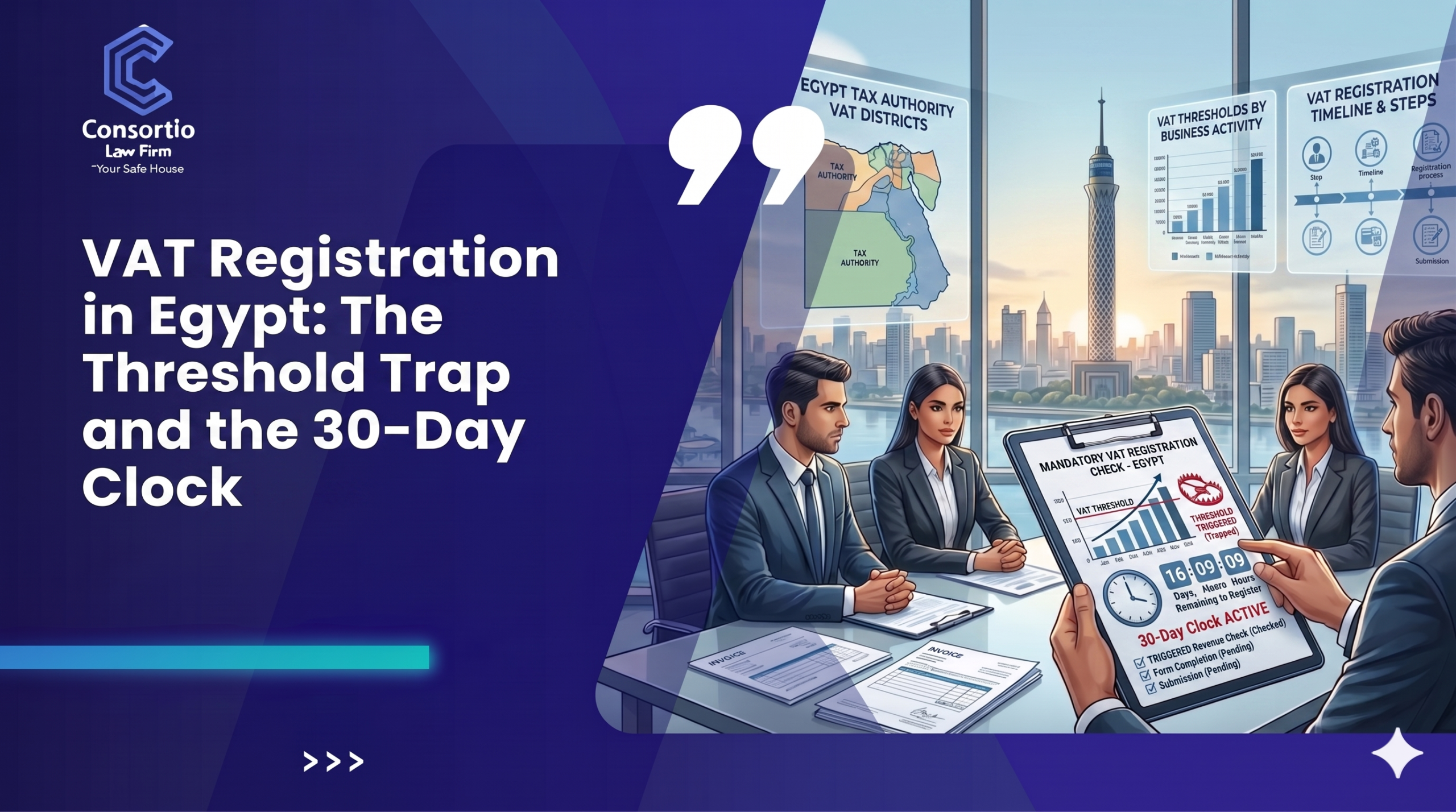
Ask most people when a business must register for VAT in Egypt, and they will name a number: half a million pounds of turnover. It feels like a comfortable runway — operate, grow, and worry about VAT once you approach the threshold. For a large category of businesses, that belief is simply wrong, and acting on it is one of the most common and most expensive mistakes a company makes when it enters the Egyptian market.
For importers, traders, distribution agents, and producers of certain goods, the registration obligation arises from the first transaction — not after any threshold. And for everyone else, the threshold comes with a short clock and a sting in the tail: if you cross it and fail to register, the law treats you as registered anyway, and liable, from the moment you crossed it.
What the law actually requires
The core rule is in Article 16 of the Value Added Tax Law (Law No. 67 of 2016).
Any natural or legal person whose total sales of taxable and exempt goods and services over the preceding twelve months reach or exceed EGP 500,000 must apply to the Tax Authority to register — and must do so within thirty days of the date their sales reach the registration threshold. The same obligation applies to any business that crosses the threshold in any financial year after the law came into force.
So far, this is the threshold most people have in mind. But Article 16 does not stop there.
The threshold does not apply to everyone. The same article provides that every importer of a taxable good or service for the purpose of trading, every exporter, and every distribution agent must register with the Authority regardless of the volume of their transactions. For these businesses, there is no half-million-pound runway. The obligation to register exists from the outset.
The same logic extends to Schedule Tax. Under Article 41 of the Law and Article 51 of the Executive Regulations (Decision No. 66 of 2017), every producer, service provider, or importer of a good or service listed in the Schedule appended to the Law must register regardless of the volume of their sales.
The trap: registrable from day one, not after the threshold
The practical effect is that an entire class of businesses is registrable from its very first taxable activity, even though its owners believe they are safely below the line.
A company set up to import goods for resale is registrable immediately. A business acting as a distribution agent is registrable immediately. A producer or importer of Schedule goods is registrable immediately. The EGP 500,000 figure is irrelevant to them — yet because it is the headline number everyone knows, it lulls exactly these businesses into thinking they have time.
This matters most for newly formed entities and foreign companies entering Egypt. A multinational establishing a local trading or import operation often assumes registration is a later-stage administrative step, to be handled once the business is up and running. In reality, the obligation may already be live before the first sale is invoiced.
The 30-day clock — and what happens if you miss it
For businesses that do register on the basis of the threshold, the thirty-day window is short and easily missed. It runs from the date sales reach the threshold, not from year-end, not from when the accountant notices, and not from when it becomes convenient.
The consequence of missing it is set out in Article 16 itself, and it is more serious than a late filing. If a taxpayer fails to apply for registration, the law provides that they are deemed registered by operation of law — and the law applies to them from the date their sales reached the registration threshold, without prejudice to the penalty provisions of the Law.
In other words, not registering does not keep a business outside the VAT system. It places the business inside the system retroactively, as of the date it should have registered — but without any of the protections or input-tax recovery that proper registration brings, and with exposure to penalties on top.
The real cost
A business that makes taxable supplies while unregistered is not in a grey area; it is in breach. Once the position is identified — typically on a tax inspection — the Authority can treat the business as having been registrable from the threshold date (or, for importers and Schedule producers, from the start of activity), and assess the VAT that should have been collected and remitted across the whole intervening period. Added to that is the Additional Tax (Surcharge) for the delay, and the penalty exposure that Article 16 expressly preserves.
For a trading or import business that has been operating for a year or more in the belief that it was below the threshold, the cumulative figure — uncollected output VAT, Surcharge, and penalties — can be severe, and it lands all at once.
What companies entering Egypt should do
Registration is a question to settle at formation, not at threshold:
- Assess registrability at set-up. Determine whether the business is an importer for trading, an exporter, a distribution agent, or a producer or importer of Schedule goods — any of which triggers registration regardless of volume.
- Do not rely on the EGP 500,000 figure unless the business genuinely falls within the ordinary threshold rule.
- Monitor the trailing twelve-month sales figure for threshold businesses, so the thirty-day clock is never missed.
- Register within thirty days of crossing the threshold, using the prescribed form.
- Regularize any past exposure before the Authority does — quantify the period of unregistered activity and address it proactively.
How Consortio can help
At Consortio Law Firm, registration is built into how we set companies up in Egypt — not treated as an afterthought. We assess each entity’s VAT and Schedule Tax position at formation, identify where registration is required from day one, manage the registration process within the deadlines, and, where a business has already been operating unregistered, quantify the exposure and regularize it on the firm’s own terms rather than the Authority’s. For international companies entering the Egyptian market, this is the difference between a clean start and a back-assessment two years in.
If you are establishing or already running a business in Egypt and are not certain whether you are registrable — or whether you should already have registered — contact Consortio Law Firm for a focused review of your VAT registration position.
Frequently asked questions
What is the VAT registration threshold in Egypt? Under Article 16 of the VAT Law, a business must register once its total taxable and exempt sales over the preceding twelve months reach or exceed EGP 500,000.
Do importers have to register for VAT in Egypt regardless of turnover? Yes. Importers of taxable goods or services for trading, exporters, and distribution agents must register regardless of the volume of their transactions — the threshold does not apply to them. Producers and importers of Schedule goods must likewise register regardless of volume.
How long do I have to register for VAT in Egypt? A business must apply to register within thirty days of the date its sales reach the registration threshold.
What happens if I don’t register for VAT in Egypt? Under Article 16, a business that fails to register is deemed registered by operation of law from the date its sales reached the threshold, and remains liable from that date — with exposure to the Additional Tax (Surcharge) and penalties.
Prepared by Consortio Law Firm — Your Safe House. This article is provided for general information only and does not constitute legal advice. For advice on your specific VAT position in Egypt, please contact Consortio Law Firm. www.consortiolawfirm.com | info@consortiolawfirm.com | +20 10 2880 6061