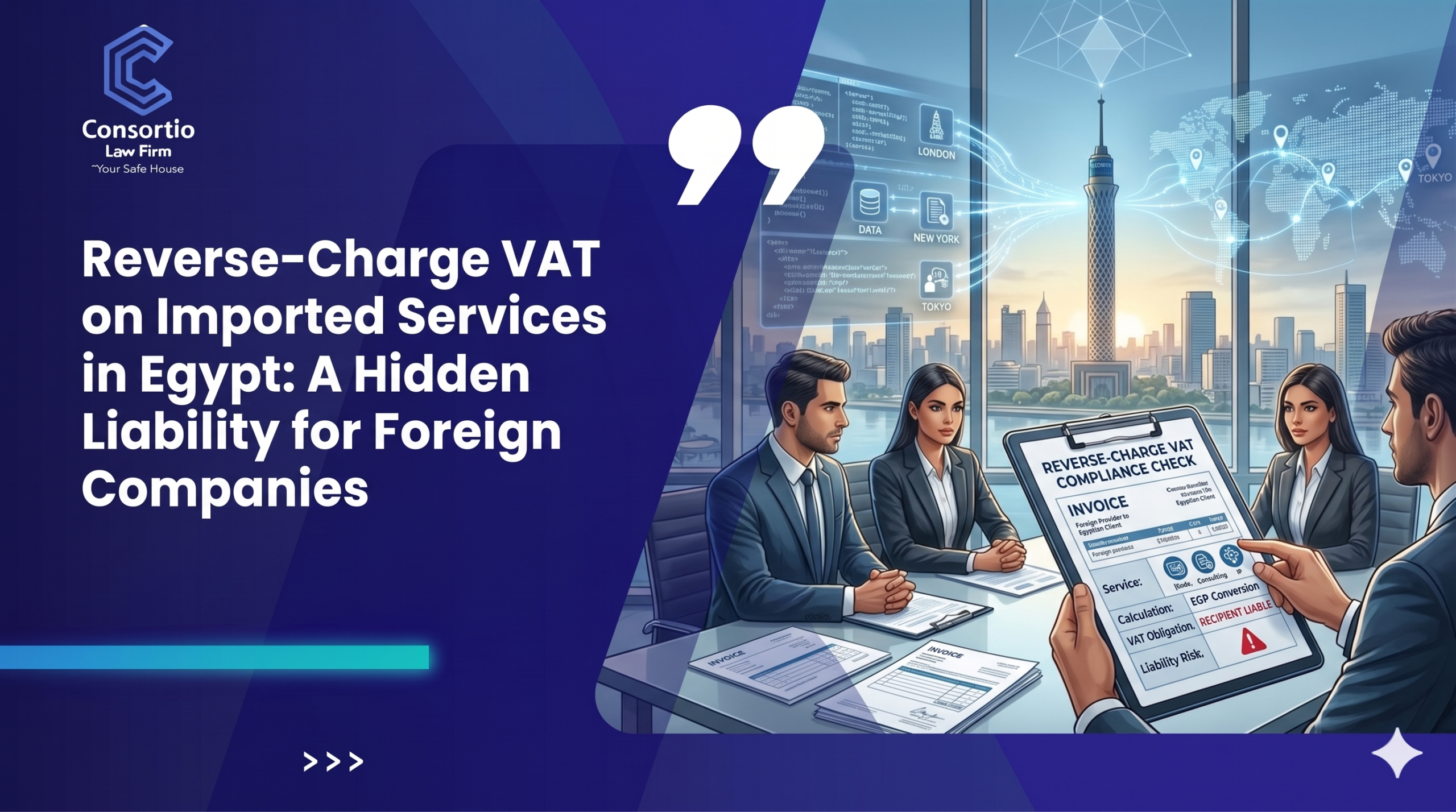
Every month, a foreign company operating in Egypt pays for services that originate abroad — management and service fees from a parent company, software and cloud subscriptions, consultants, marketing agencies, engineering support, intellectual property licenses. None of these foreign suppliers charges Egyptian VAT. So the VAT is never recorded. And quietly, transaction by transaction, a tax liability builds — one that does not appear on any invoice and that typically surfaces, with interest attached, during a tax audit.
This is the reverse-charge mechanism, and it is among the most commonly overlooked VAT obligations in Egypt — particularly for multinationals with a local branch or subsidiary. Understanding it is essential for any business operating under Egyptian law.
What the law actually requires
The obligation comes from Article 32 of the Value Added Tax Law (Law No. 67 of 2016).
Where a person who is non-resident and not registered with the Egyptian Tax Authority supplies a service into Egypt — to a registered business, a government body, a public or economic authority, or any other entity — it is the recipient of the service, not the foreign supplier, who must calculate the VAT due on that service and pay it to the Authority within thirty days of the transaction.
Article 42 of the Executive Regulations (Ministerial Decision No. 66 of 2017) confirms the mechanics: the beneficiary of the imported service self-assesses the tax and remits it within thirty days of the date of supply.
In plain terms: when you buy a service from abroad and the foreign provider is not registered for VAT in Egypt, the law treats you as the party responsible for the tax. You account for it as if you were both the supplier and the customer.
There is one exception. Where the non-resident supplier is itself registered under Egypt’s Simplified Supplier Registration System — the regime introduced for non-resident digital suppliers — the obligation to charge and remit shifts back to that supplier, and the reverse charge does not apply.
Who this catches — usually more than expected
The reverse charge applies to imported services, which is a far broader category than most finance teams assume. It commonly captures:
- Intra-group management and service fees charged by a parent company or affiliate abroad
- Software, SaaS, and cloud subscriptions
- Consultancy and advisory services
- Marketing and advertising services
- Engineering, technical, and design services
- Intellectual property royalties and license fees
The common thread is simple: the provider sits outside Egypt and is not registered for Egyptian VAT. If that is the case, the service almost certainly falls within the reverse-charge regime.
The most exposed businesses are multinationals with an Egyptian subsidiary or branch that receives services from the wider group. Cross-border intra-group charges are the classic blind spot — they are booked as ordinary intercompany costs, and because no Egyptian supplier ever issues a VAT invoice, the reverse-charge liability is simply never recognized.
The thirty-day clock and how the tax is calculated
The recipient must calculate VAT at the standard rate on the value of the imported service, then declare and pay it to the Tax Authority within thirty days of the transaction.
Article 32 goes further for corporate taxpayers: legal persons that fall under the reverse-charge mechanism set out in Article 17 of the Law and that import services must likewise self-account for the VAT due and pay it within thirty days of the date the service is supplied — again, unless the non-resident provider is registered under the Simplified Supplier Registration System.
The real cost of getting it wrong
Because the liability is invisible — there is no supplier invoice prompting anyone to act — it tends to accumulate silently, often across several years, until a tax inspection brings it to light. At that point the Authority can assess the entire unpaid amount in a single back-assessment.
On top of the tax itself, Egypt’s Additional Tax (Surcharge) runs at a rate set by law for every month of delay, calculated from the date the tax was due until the date it is finally paid. Over a multi-year period of unrecognized reverse-charge VAT, the Surcharge alone can be significant. In serious cases, the broader penalty regime — including fines and exposure to evasion provisions — may also come into play.
For a company that has been operating in Egypt for several years without accounting for reverse-charge VAT on its imported services, the eventual assessment is rarely small.
The digital-economy dimension
The reverse charge does not sit in isolation. Following the 2023 reforms to the Executive Regulations, non-resident digital suppliers selling into Egypt are expected to register under the Simplified Supplier Registration System and account for VAT themselves. The reverse-charge rule and the non-resident registration regime are therefore two sides of the same coin: between them, they are designed to ensure that VAT is captured on virtually every service consumed in Egypt, whoever provides it and wherever they are based.
For a business receiving foreign services, the practical question is always the same: is my supplier registered in Egypt or not? The answer determines who carries the tax.
What companies operating in Egypt should do
A reverse-charge exposure is straightforward to manage once it is identified, and costly to ignore. The essential steps are:
- Map every cross-border service payment the Egyptian entity makes.
- Identify which providers are non-resident and not VAT-registered in Egypt.
- Build reverse-charge self-assessment into the monthly VAT return so the tax is declared and paid within the thirty-day window.
- Reconcile accounts payable against the reverse-charge rule, so no imported service slips through unrecorded.
- Review historical exposure — quantify any past liability before the Authority does, and regularize the position on the firm’s own terms.
How Consortio can help
At Consortio Law Firm, we help international companies operating in Egypt identify and close exactly these kinds of silent exposures — before they become an audit assessment. Our VAT compliance work covers reverse-charge mapping, registration strategy, return support, and the quantification and regularization of historical liabilities, integrated with the wider tax and corporate structuring of your Egyptian operation.
If your business pays for services from abroad and you are not certain those payments are being treated correctly for VAT, that uncertainty is itself the risk. Get in touch with Consortio Law Firm for a focused review of your reverse-charge position.
Frequently asked questions
What is reverse-charge VAT in Egypt? It is a mechanism under which the recipient of a service — rather than the supplier — accounts for and pays the VAT. In Egypt it applies where a non-resident, non-registered provider supplies a service into the country.
Who pays VAT on imported services in Egypt? Under Article 32 of the VAT Law, the Egyptian recipient of the service is responsible for calculating and paying the VAT, unless the foreign supplier is registered under the Simplified Supplier Registration System.
What is the deadline to pay reverse-charge VAT? The recipient must remit the tax to the Egyptian Tax Authority within thirty days of the date of the transaction or supply.
What happens if reverse-charge VAT is not paid? The unpaid tax remains due and accrues the Additional Tax (Surcharge) for each month of delay. Because the liability is not prompted by any supplier invoice, it often accumulates unnoticed until a tax audit, when it can be assessed in full with accrued Surcharge.
Prepared by Consortio Law Firm — Your Safe House. This article is provided for general information only and does not constitute legal advice. For advice on your specific VAT position in Egypt, please contact Consortio Law Firm. www.consortiolawfirm.com | info@consortiolawfirm.com | +20 10 2880 6061