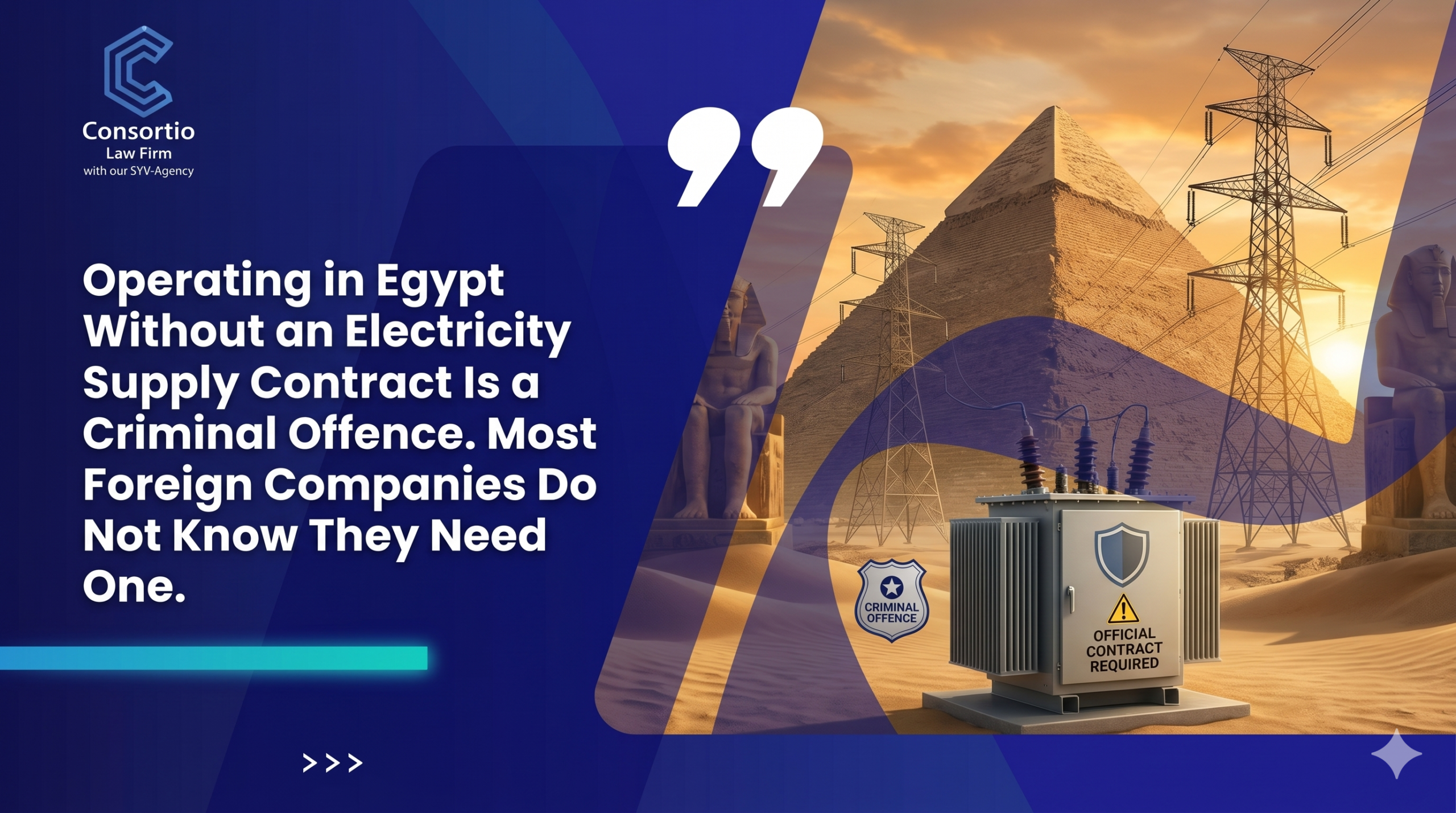
A foreign technology company deploys a team of engineers at an Egyptian petroleum facility. The engineers work on-site for six months — installing equipment, commissioning systems, running tests. They consume electricity throughout. The facility’s management never raises the issue. The commercial contract says nothing about it.
Two years later, the Egyptian prosecutor’s office opens an inquiry. The company has been taking electricity without legal right. That is a criminal offence under Article 71 of Egyptian Electricity Law No. 87 of 2015, as amended by Law No. 192 of 2020. The court is required by law to repay double the value of all electricity consumed. The company’s Egypt operations manager bears personal criminal liability.
The company assumed it was covered by the facility’s supply arrangement. It was not.
Article 70 and Article 71: Why the Distinction Matters
Law No. 192 of 2020 replaced the text of both Article 70 and Article 71 of the Electricity Law. The two provisions are frequently confused. Understanding which one applies to a foreign company requires reading both.
Article 70 targets persons acting within the electricity sector in the course of their professional duties — specifically, employees or contractors who connect electricity to individuals or entities without legal basis, or who refuse to provide licensed services. The criminal exposure under Article 70 is conditioned on the offender acting “during the performance of their duties in the field of electricity activities.” This is a sector-professional provision.
Article 71 contains no such qualification. It applies to anyone who takes electricity without legal right — “كل من استولى بغير حق على التيار الكهربائي.” No profession is required. No sector affiliation is required. No scale threshold applies. A foreign company operating at an Egyptian facility whose electricity consumption has no documented legal basis is within the scope of Article 71 regardless of what it does or who it is.
The mandatory repayment obligation under Article 71 is also unconditional. The law states it in the strongest possible terms: “وفي جميع الأحوال” — in all cases. The court must order repayment of double the value of electricity consumed. This obligation exists independent of whether the court imposes imprisonment, a fine, or neither. It is not a sentencing option. It is a mandatory civil consequence that attaches to every Article 71 conviction without exception.
Under Article 70, by contrast, the mandatory double repayment is limited to the illegal-connection scenario — it does not apply to the refusal-of-service scenario. This distinction is legally significant but practically irrelevant to the foreign company situation, which falls under Article 71, where no such limitation exists.
The Penalty
Article 71 carries imprisonment for not less than six months and a fine of not less than EGP 10,000 and not more than EGP 100,000, or either penalty at the court’s discretion. For a repeat offence, imprisonment rises to not less than one year and the fine doubles to a range of EGP 20,000 to EGP 200,000, or either penalty.
In all cases, the court mandatorily orders the convicted party to repay double the value of electricity consumed. For a company that operated at an Egyptian petroleum facility for twelve months without documented consumption entitlement, that figure alone — before any fine or legal costs — is a material financial exposure.
The Personal Criminal Liability Dimension
Article 78 of the Electricity Law extends criminal liability beyond the legal entity. The actual manager of the legal entity — the individual responsible for its operations in Egypt — bears the same criminal penalties for violations committed in the entity’s name and with their knowledge and intent. The legal entity bears joint and several liability for all financial penalties and damages.
For a foreign company with an Egypt country manager or regional director overseeing on-site operations, this provision means the individual faces exposure, not just the company. The size of the company, its international standing, and the value of the contract it holds with the Egyptian state entity do not affect the personal exposure of the responsible manager.
Why Foreign Companies Face This Risk
The problem is not unusual conduct. It is a structural assumption that most foreign companies make without questioning it.
A company enters an Egyptian facility under a partnership agreement with a state entity. The state entity provides the site, the access, and the operational environment. The foreign company provides the technology, the personnel, and the services. Electricity is used throughout. No one in the commercial negotiation raises the question of a separate electricity supply arrangement because no one on either side thinks to ask.
The foreign company assumes its consumption is covered by the facility’s existing supply arrangement. That assumption is legally incorrect. An electricity supply relationship in Egypt requires a valid contractual basis between the consuming entity and the licensed supplier or distribution company. The existence of a broader commercial arrangement with the facility operator does not create that contractual basis. The facility’s supply contract covers the facility’s consumption, not the consumption of visiting foreign contractors operating under a separate commercial agreement.
This gap is invisible until it becomes a prosecution.
The Reconciliation Option — and Its Cost
Article 71 provides that criminal proceedings are extinguished if reconciliation is reached in accordance with Articles 18 bis, 18 bis/A, and 18 bis/B of the Egyptian Code of Criminal Procedure. Reconciliation is available. But its cost mirrors the mandatory repayment that a conviction would impose — double the value of electricity consumed.
The difference between reconciliation and conviction is that reconciliation extinguishes the criminal proceedings before a conviction is recorded. For a company that values its regulatory standing in Egypt, its relationship with the state entity, and its international compliance record, that difference is significant. The financial exposure, however, is the same either way.
Reconciliation procedures under the Electricity Law are subject to ongoing legislative development. Amendments approved in December 2025 would introduce a more detailed framework with payment thresholds that vary depending on whether settlement is reached before or after referral to court. These amendments should be verified against the Official Gazette before advising any client on current reconciliation procedures.
What the Correct Position Looks Like
A foreign company operating within or alongside an Egyptian electricity subscriber needs a documented basis for its electricity consumption before operations begin. The form that takes — a sub-supply arrangement, a consumption allocation documented in the commercial agreement with the facility operator, or a direct arrangement with the licensed distributor — depends on the structure of the engagement and requires legal assessment of the applicable provisions.
What it cannot take is the form of silence. The assumption that consumption is covered, when nothing in writing says it is, is the position that creates Article 71 exposure.
The time to establish the documentation is before the first engineer arrives on-site. Once consumption has commenced without a documented basis, the question is no longer whether a risk exists. It is how to remediate an existing position — a different and more expensive conversation.
This article is prepared for general information purposes only. It does not constitute legal advice and does not create a lawyer-client relationship. Egyptian electricity regulation involves specific procedural requirements that vary by installation type and operational structure. For advice on a specific transaction, contact Consortio Law Firm.
© Consortio Law Firm — “Your Safe House” — Cairo, Egypt — www.consortiolawfirm.com