France has a long-standing commercial relationship with Egypt. French companies — across industrial manufacturing, energy, infrastructure, consumer goods, and professional services — have been establishing and expanding Egyptian operations for decades. Yet the legal and regulatory environment in Egypt remains genuinely complex, and the gap between French corporate standards and Egyptian procedural realities is one that consistently catches even experienced international companies off guard.
This article explains what French companies typically face when entering or operating in Egypt, and how Consortio Law Firm structures its advisory model to serve sophisticated international clients navigating this market.
What French Companies Actually Encounter in Egypt
French companies entering Egypt typically arrive with a clear commercial objective — a distributor relationship to formalize, a tender to participate in, a subsidiary to establish, or a joint venture to structure. What they often underestimate is the regulatory density surrounding each of these steps.
Egypt has its own investment law framework, its own company formation procedures, its own licensing ecosystem, and its own approach to commercial agency relationships. None of these translate directly from French or European legal experience. And the consequences of getting the structure wrong at entry — choosing the wrong legal vehicle, missing a licensing obligation, or entering a distribution arrangement without proper contractual protection — are costly to correct later.
The most common issues French companies bring to Consortio include:
Entity selection and market entry structuring. Should the French parent establish a branch, a subsidiary LLC, or a representative office? Each has different tax implications, operational scope, liability exposure, and registration requirements. The right answer depends on what the company intends to do in Egypt — not on which option appears simplest to register.
Commercial agency and distribution disputes. Egypt’s commercial agency framework is one of the most consequential legal areas for foreign companies. An improperly drafted distribution agreement — or an undocumented commercial relationship — can create deemed agency claims that are extremely difficult and expensive to exit. French companies frequently encounter this issue when attempting to terminate or restructure relationships with local Egyptian partners.
Contract drafting and enforcement. French companies operating under standard European contractual frameworks often find that their standard templates are poorly adapted to Egyptian enforcement realities. Contracts that are legally sound under French law may contain arbitration clauses that are unenforceable in Egypt, payment security mechanisms that are insufficient, or delivery and acceptance terms that create evidentiary problems in Egyptian courts.
Regulatory licensing. Depending on the sector — industrial manufacturing, food production, pharmaceutical, technology, logistics — operating in Egypt may require licensing from authorities beyond GAFI. French companies in regulated sectors often discover these requirements only after their entity is established, creating delays in operational launch.
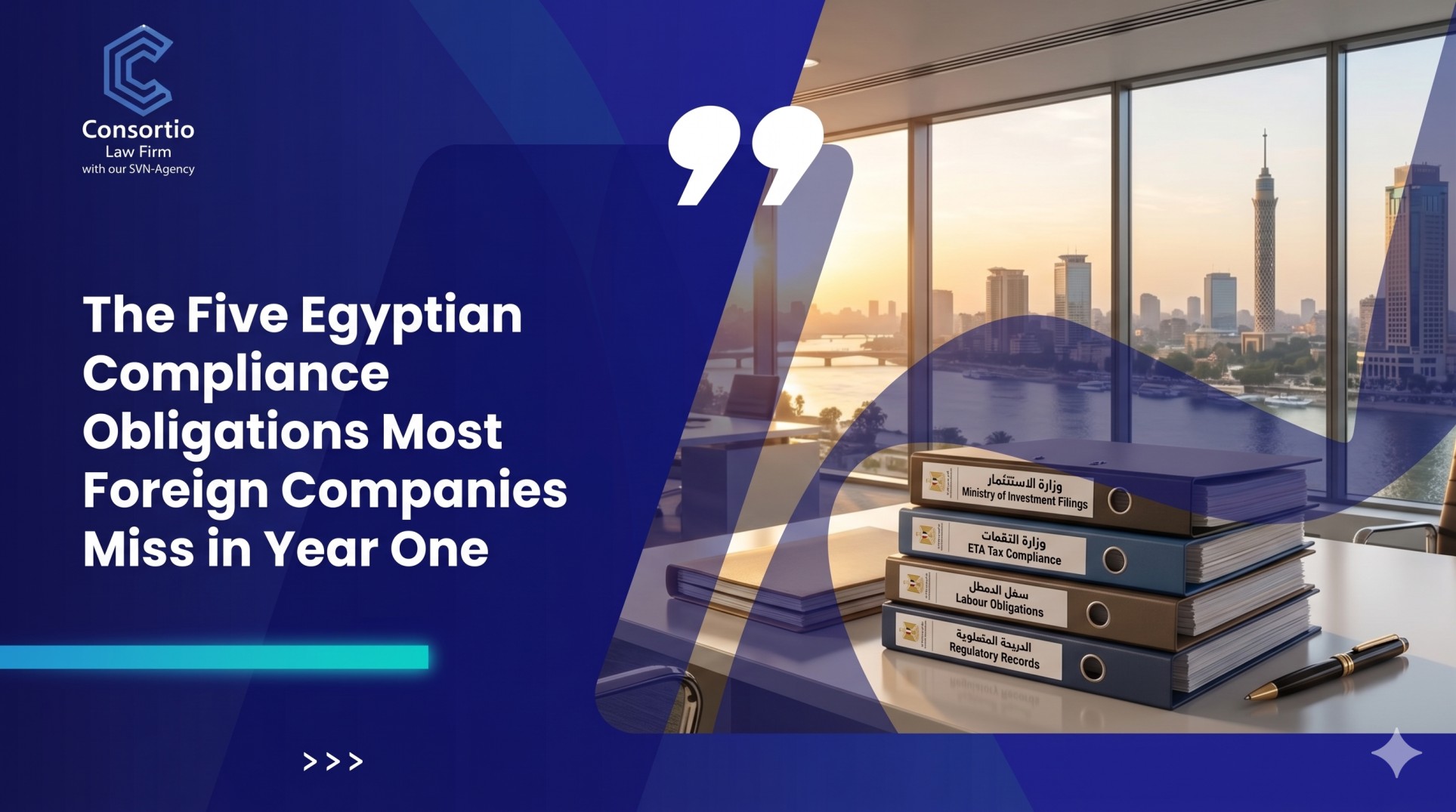
Ongoing compliance. Corporate tax at 22.5%, VAT obligations, social insurance for employees, annual GAFI filings, and labor law compliance all create a continuous administrative burden that requires local legal and accounting coordination. French companies with Egyptian subsidiaries need a reliable local partner who can manage this layer without requiring constant escalation to headquarters.
How Consortio Structures Its Support for French Companies
Consortio does not operate as a transactional legal executor. Its model is built around understanding the client’s business first, then designing the legal structure that fits — rather than defaulting to the most common structure and adjusting later.
For French companies, the engagement typically begins with a structured market entry assessment. This covers the intended activity in Egypt, the regulatory environment for that activity, the appropriate legal vehicle, the likely compliance obligations from day one, and the full establishment roadmap before any registration begins.
This approach ensures that French legal and compliance teams — who typically oversee the Egyptian entry from headquarters — have a complete picture before commitment. Consortio provides the kind of structured, documented guidance that integrates with how French corporate legal departments actually operate: written frameworks, clear reasoning, documented steps, and organized data rooms rather than fragmented email exchanges.
The firm’s core service areas for French companies include:
Market entry and legal structuring — entity selection, establishment, and regulatory mapping before and during the formation process.
Commercial contracts and distribution agreements — drafting and reviewing contracts adapted to Egyptian enforcement realities, with particular attention to agency risk, payment security, and dispute resolution.
Litigation and commercial disputes — representing French companies in Egyptian commercial courts and arbitration, including agency termination disputes, contractual enforcement, and judgment execution.
Ongoing legal counsel — acting as the Egyptian legal department for French companies that need continuous local legal support without the cost of an internal team.
Compliance coordination — working alongside the company’s auditors and accountants to ensure that corporate, tax, and employment compliance obligations are met in an organized and documented way.
What French Companies Value in a Legal Partner in Egypt
French corporate clients consistently prioritize the same qualities in an Egyptian legal partner: structured communication, complete explanations, documented advice, and a firm that behaves as a strategic partner rather than a reactive executor.
Consortio’s model is built around these expectations. Responses are detailed and structured. Advice is accompanied by reasoning, not just conclusions. Data rooms are organized and maintained. Timelines are respected. And the relationship is designed around continuity — supporting the French company throughout its lifecycle in Egypt, not only at entry.
A Note on Language and Cross-Border Coordination
Consortio operates in both Arabic and English, and coordinates regularly with foreign legal counsel, including European firms representing French clients with Egyptian operations. This allows the firm to function as the Egyptian arm of a cross-border legal structure — receiving instructions from French counsel, translating them into Egyptian legal action, and reporting back in a format that integrates with the parent company’s governance requirements.
For French companies that already have legal counsel at the group level, Consortio works as a specialist Egyptian partner within that structure — not as a replacement for existing relationships, but as the on-the-ground execution layer that ensures Egyptian operations are legally sound.
Starting the Conversation
If your company is evaluating Egypt as a market, or if you are already operating in Egypt and need a more structured legal partnership, Consortio provides an initial structured assessment of your situation before any formal engagement begins.
This assessment covers your intended activity, the regulatory environment, the right legal structure, and the compliance obligations you will need to manage — giving your legal and management teams a clear picture before any commitments are made.
Contact Consortio Law Firm: 📞 +20 102 880 6061 ✉️ Info@consortiolawfirm.com 🌐 www.consortiolawfirm.com