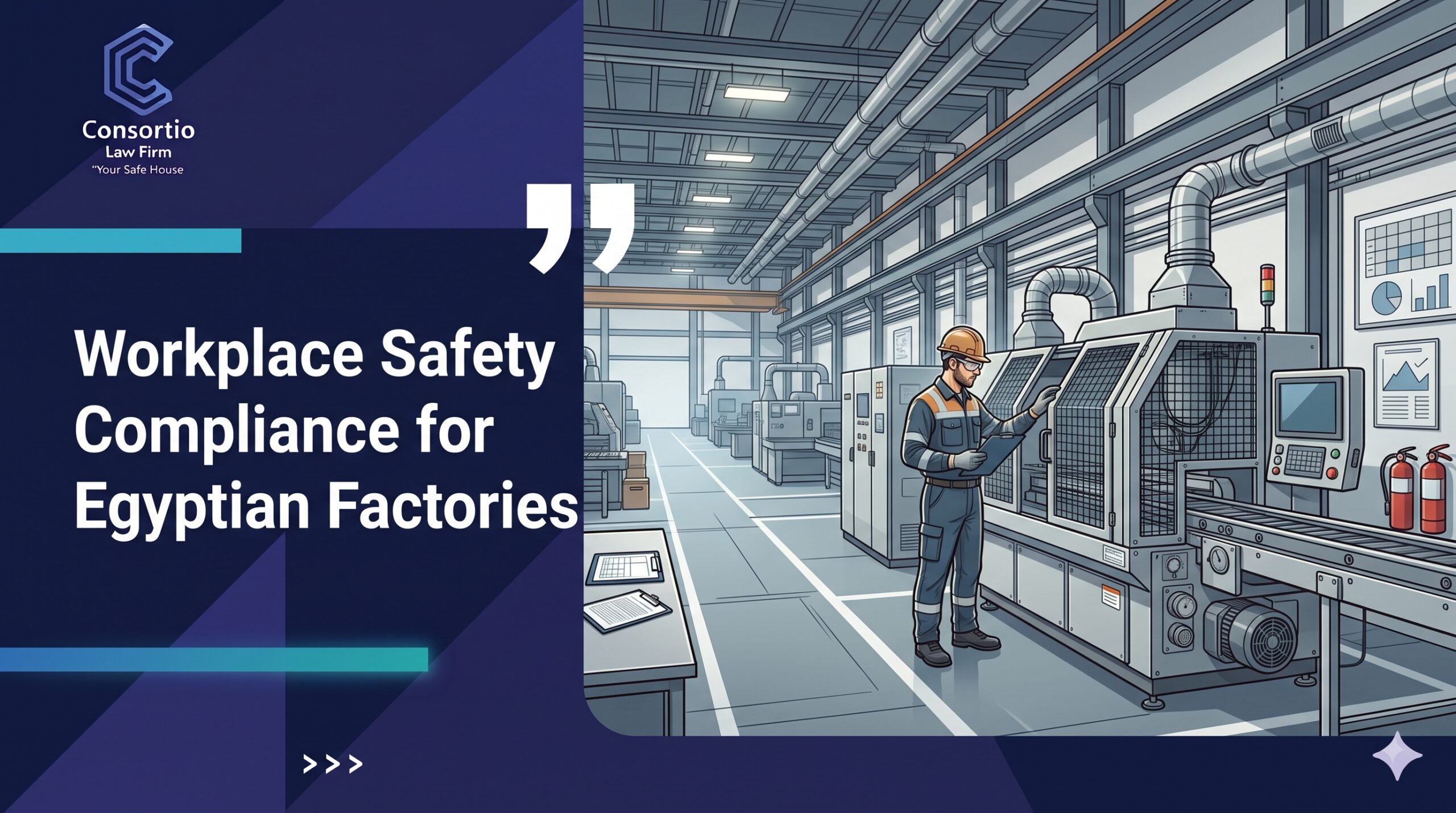
A factory can have personal protective equipment and still fail its safety obligations. Egyptian Labour Law No. 14 of 2025 requires the company to identify hazards, control them, train workers, test emergency arrangements, inspect every shift and retain evidence. Reporting a serious incident is a separate duty from preparing the periodic accident statistics.
This guide explains the duties relevant to plant management, HR and occupational safety teams. Article 244 extends the safety book to workplaces, establishments and branches regardless of their type or affiliation, including land, maritime and air operations, water surfaces and transport. The English quotations below are working translations of the Arabic law, not official translations.
1. Start with the hazards of the actual process
Articles 246–252 require protective measures matched to the workplace. A risk register should identify the applicable legal category and the actual controls, rather than record only that a generic safety policy exists.
| Legal provision | Hazards and required focus | Practical evidence |
|---|---|---|
| Article 246 | Physical hazards: heat and cold, noise and vibration, lighting, harmful ionising and non-ionising radiation, atmospheric-pressure changes and explosion hazards, with applicable exposure standards and limits. | Process survey, competent measurements and the applicable technical limits. |
| Article 247 | Engineering hazards: machinery, lifting and pulling equipment, handling and transmission of movement; construction, excavation, collapse and falls; dynamic and static electricity; fit between the worker, equipment and workplace. | Guarding, isolation procedures, lifting checks and task assessments. |
| Article 248 | Biological exposure where the work creates a risk, including contact with infected people, animals, medical and veterinary waste, and waste reception, storage or treatment. | Exposure assessment and controls for the particular biological pathway. |
| Articles 249–250 | Chemicals, carcinogens and indirect hazards, including rescue and first aid, cleanliness, order and organisation. Food and drink handlers need the prescribed health certificates showing freedom from epidemic and infectious diseases. | Chemical records, labels, housekeeping and applicable health certificates. |
| Articles 251–252 | Fire precautions prescribed by the competent Ministry of Interior body, and protection against hazards of work in confined and enclosed spaces. | Applicable fire requirements and task-specific entry and rescue arrangements. |
The evidence column gives suggested implementation records; it does not replace the statutory duties. Article 255 leaves the detailed safety rules, exposure standards, limits and precautions to ministerial decisions coordinated with the relevant authorities. Identify the decisions that actually govern the plant and substance before specifying an exposure limit. The law alone does not supply a universal safe concentration for every solvent.
2. A chemical inventory must be connected to handling and training
Article 249(4)–(6):
“Keep a paper or electronic register listing the hazardous chemical substances in circulation, including all information specific to each substance, and a register monitoring pollution of the work environment to which workers are exposed, and a register of hazardous substances and waste in accordance with the Waste Management Regulation Law promulgated by Law No. 202 of 2020.
Place identification cards on all chemical substances in circulation at work, stating their scientific and commercial name, chemical composition, degree of hazard, and the safety precautions and related emergency procedures. The establishment shall obtain those data from the supplier or manufacturer upon supply.
Train workers in the methods of handling hazardous chemical substances and carcinogenic substances, inform them of their risks, and of the methods of safety and protection against those risks.”
The remaining parts of Article 249 require compliance with maximum permitted concentrations, substance-specific storage thresholds, precautions during handling, transport, storage, use and waste disposal, and exposure standards and limits. A purchasing approval for a new solvent should therefore trigger collection of its data, an updated inventory and pollution-monitoring plan, confirmation of storage conditions, and worker instruction before use.
Batch numbers, store locations, responsible persons and review dates are useful additional internal fields. They should be labelled as company controls, rather than presented as an exhaustive list of fields expressly prescribed by the law.
3. Risk assessment and emergency plans must be tested
Article 253 requires assessment and analysis of risks, industrial and natural disasters and disasters resulting from operations; emergency plans protecting the establishment, workers and visitors; practical tests of their effectiveness; worker training; and correction where necessary. The company must notify the competent administrative authority of its plans and amendments, and also where hazardous materials are stored or used. The article permits a consultant or licensed specialist centre to assist with preparing the plans.
If an anticipated accident or workplace hazard creates an imminent and serious threat to workers’ health or life, Article 253 permits workers to leave the workplace for another place within the establishment or outside it if necessary, without permission. They must immediately notify the direct supervisor of the danger. That withdrawal must not result in punishment or disciplinary accountability, and return to an unsafe environment is prohibited until the danger is removed.
Article 253’s enforcement route concerns failure to implement that article and its implementing decisions within the authority’s deadlines, producing imminent danger to workers or visitors. The authority must order full or partial closure or stop one or more machines until the danger is removed. Administrative enforcement does not prejudice workers’ entitlement to wages during the full or partial stoppage. The authority may remove the danger directly at the establishment’s expense in coordination with the relevant bodies.
Article 257 is a separate inspection route. Inspectors may examine workers, take material samples, examine plans and risk analyses, inspect accident reports and dangerous-stock quantities and use equipment to analyse accidents. On the inspection body’s report, imminent danger to the establishment, workers, visitors or work-environment safety requires closure or machinery stoppage until the causes are removed, with wages protected. The authority cancels the closure or stoppage immediately once those causes disappear. Neither route means that every missing document automatically causes closure; the statutory trigger matters.
4. Put Article 260’s separate reporting duties in the calendar
Article 260, first two paragraphs:
“Every establishment employing thirty workers or more shall provide the competent administrative authority with a half-yearly statistical return containing accurate data on ordinary and chronic diseases, serious accidents and injuries, during the first half of July and January at the latest.
Every establishment subject to this Book shall notify the competent administrative authority of every serious accident occurring at the establishment or the appearance of symptoms of an occupational disease, within twenty-four hours of its occurrence. The competent Minister shall issue the forms used for this purpose.”
| Trigger | Timing and scope | Record to retain |
|---|---|---|
| Thirty workers or more | Half-yearly statistics in the first half of January and July, covering the data specified above. | Completed applicable form, source data and filing receipt. |
| Serious accident or appearance of occupational-disease symptoms | Notify within 24 hours of the event. This duty covers every establishment subject to the safety book; it is not limited to those with 30 workers. | Event and discovery chronology, notification and evidence of receipt. |
| Electronic reporting | The final paragraph also requires all covered establishments to provide necessary data, reports and statistics electronically through the platform and under the arrangements determined by ministerial decision. | Applicable platform instructions and electronic submission record. |
Do not postpone urgent notification until the next statistics return or assume that a final medical diagnosis is required before acting on the statutory trigger of symptoms. Confirm the operative form and submission channel with the competent authority.
5. Medical fitness, free protection and inspection every shift
Article 266 requires a pre-employment medical examination suited to the work and an assessment of physical, mental and psychological abilities against the job requirements, under the health-insurance rules and implementing standards. Article 267 requires safe-work training, explanation of occupational hazards, appropriate personal protective equipment and instruction in its use. The employer cannot charge workers for the necessary protection or deduct its cost from wages. Article 268 separately requires workers to use and care for protective equipment and comply with safety instructions.
Under Article 269, the establishment must inspect workplaces daily in every work shift, particularly dangerous locations, detect and prevent occupational hazards and maintain a paper or electronic register. It must examine workers’ medical complaints and their connection with the work through its doctor, if any, and coordinate periodic and end-of-service examinations with the Health Insurance Authority under its rules.
Article 270 requires first-aid facilities. Where the establishment’s workers in one place, one town or a circle with a radius of fifteen kilometres exceed fifty, it must employ one or more qualified nurses for nursing or first aid in each shift, arrange for a doctor to treat workers at the place provided, and supply necessary treatment medicines free of charge. Where a worker in the specified cases is treated at a government or charitable hospital, the establishment bears the treatment, medicine and accommodation costs under the prescribed arrangements. The threshold is more than fifty, and the geographical aggregation must not be ignored.
6. The penalty provisions must be read as written
Article 296:
“Anyone who contravenes Articles (245, 254, 255, 259, 260, 261, 262, 266, 270, 271, 272) of this Law and the ministerial decisions implementing them shall be punished by a fine of not less than five thousand pounds and not more than one hundred thousand pounds. The fine shall be doubled in the event of recurrence.
The same penalty provided in the first paragraph of this Article shall also apply to anyone who contravenes Articles (246, 247, 248, 249, 250, 251, 252, 253, 267, 268, 269) of this Law.”
Article 296 does not state that this fine is multiplied by the number of workers, nor does its reproduced text prescribe a separate injury-or-death enhancement. Article 280 preserves any more severe penalty under another applicable law. Other liability must be analysed on its own legal basis rather than added to Article 296 by assumption.
Article 298 makes the person responsible for actual management liable to the relevant penalty if knowledge of the offence is proved and breach of managerial duties contributed to it. The legal entity is jointly liable for financial penalties and compensation. A job title alone is not the stated test. Article 254’s safe and non-hostile workplace obligation is referenced in both Articles 288 and 296; a harassment or violence case requires analysis of that overlap and its facts, not an automatic selection of one fine.
7. Example: symptoms after use of a new solvent
Suppose a factory has 42 workers and occupational-disease symptoms appear following solvent use. Management should first protect people and control the exposure, arrange medical assessment, preserve the chemical and exposure records, and notify the competent authority within the Article 260 period. The safety team should reassess storage, ventilation, handling, training and emergency arrangements and record corrective action. The incident also feeds the half-yearly return because the establishment meets the 30-worker threshold. These are separate actions; the example does not establish a diagnosis or predict a court penalty.
As an internal allocation of responsibility, operations can own the process and shift inspections, the safety team the technical controls and emergency exercises, HR the training and medical arrangements, and legal the notices and applicable decisions. Retain the assessment, chemical data, training records, exercise results, plan notifications, shift registers, medical referrals and submission receipts.
Contact Consortio Law Firm to review how these duties apply to your factory and its operating risks.
Sources: Labour Law No. 14 of 2025, Articles 242–270, 280, 288, 296 and 298. The Arabic library copy was checked at PDF pages 50–56 and 60–61 for the principal safety provisions. The plant’s applicable technical ministerial decisions, prescribed forms and platform instructions must be identified for implementation.
Related resource: English translation of Egyptian Labour Law No. 14 of 2025.