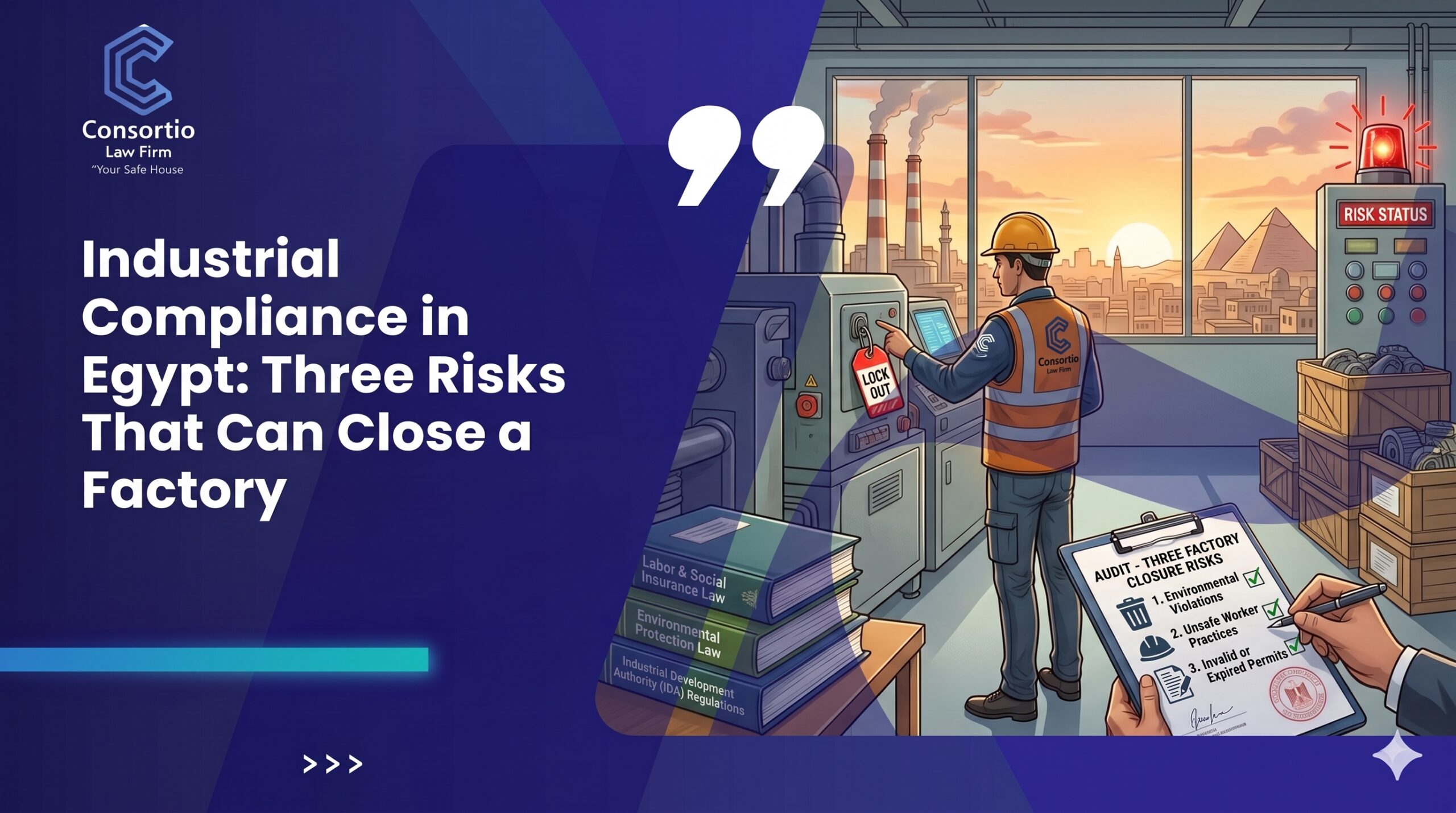
For a foreign manufacturer, obtaining an industrial licence in Egypt is the beginning of compliance, not the end of it. Under Law No. 15 of 2017 — the Industrial Establishment Licensing Facilitation Law — a factory that is fully licensed on day one can still be fined, sealed, or expose its managers to criminal liability if it mishandles what comes next.
Across the law and its executive regulation (Ministerial Decree 1082/2017), three issues account for most of that exposure. Each is easy to overlook, and each carries consequences that reach the plant, the balance sheet, and the individuals running the operation. This article sets out all three, and what a manufacturer should do about them.
Risk 1: Operating — or growing — without the right authorisation
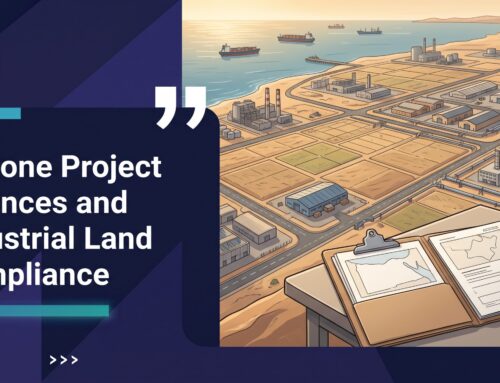
Article 2 of Law 15/2017 is deliberately broad. No one may establish, manage, operate, expand, change the industrial purpose of, or relocate an industrial establishment without a licence issued under the law — and no other authority’s approval can stand in its place. That single sentence is where most licensing failures begin, because it captures far more than the initial set-up.
The law runs on two systems, and which one applies depends on the risk level of the activity, not the wishes of the investor. Activities listed on the schedule annexed to the executive regulation require the prior-licence system — approval before operating. Everything not listed falls under the lighter notification system, where the stamped notification itself operates as the licence (Articles 11 and 15 of the regulation).
The trap for an established, growing manufacturer is that ordinary business decisions re-trigger the process:
- An expansion, a change of product, or a change of the licensed purpose each require the licensing route to be followed again.
- A relocation is not a transfer of the existing licence — the regulation treats a move to a new site as a brand-new licence (Article 27).
- Growth can even change the regime: if an expansion or change of activity brings the factory onto the annexed schedule, it must re-qualify under the stricter prior-licence system (Article 29).
The penalties make the classification a commercial issue, not a clerical one. Operating a prior-licence activity without a licence can bring imprisonment of up to one year, a fine of EGP 100,000 to 5,000,000, and mandatory closure of the plant (Article 40). Operating a notification activity without filing the notification carries a fine of EGP 10,000 to 200,000 and possible closure, and filing false data in the notification is separately punishable (Article 41).
Risk 2: Missing the conditions the committee actually sets
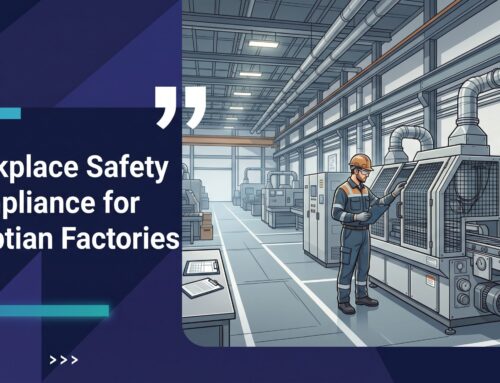
Manufacturers often assume that “compliance” simply means reading the Environmental Law, the Civil Defence Law, and the labour rules and applying them. Under Law 15/2017, that assumption is incomplete — and the gap is exactly where inspections bite.
Article 14 creates a Licensing Conditions Committee and gives it the power to set the conditions for a licence — covering civil defence, the environment, industrial security, safety, and occupational health — without being bound by the rules laid down in any other law (دون التقيّد بأي قانون آخر). In other words, the binding baseline for your factory is the committee’s consolidated set of conditions, not your own reading of the underlying statutes.
So where do those conditions live? They are issued by ministerial decision and published in an online Industrial Activity Practice Guide (دليل ممارسة النشاط الصناعي), which the authority maintains and updates (Articles 8 and 9 of the regulation). Because it changes over time, compliance is a live obligation: the conditions that applied when you were licensed are not necessarily the ones an inspector will check against next year.
Moreover, inspection is not always scheduled. The regulation sets out three modes, and, crucially, only some come with warning (Article 31):
- Initial inspection — at least one working day’s notice.
- Periodic follow-up — at least 30 days’ notice.
- Surprise inspection — no prior notice at all.
A credible compliance programme therefore has to assume that an inspector could arrive unannounced on any working day, and that the factory must be able to demonstrate the current conditions at that moment — not after a scramble to prepare.
Risk 3: Material change, revocation, and closure
The third risk sits at the intersection of the first two, and it is where a licensing slip escalates into losing the licence altogether.
The regulation defines a material modification as any change to the establishment that requires altering the conditions under which the licence was issued (Article 3(7)). Such a change cannot be made without going back through the licensing process (Article 28) — and, as noted above, if it pushes the activity onto the annexed schedule, the plant must re-qualify under the prior-licence system (Article 29).
Article 35 of the law then lists the grounds on which a licence is revoked. They include stopping work for more than two years without acceptable justification, making a material modification without a licence, the plant becoming an imminent danger to security, health, safety or the environment, and — a deceptively simple one — failing to renew the licence within two months of its expiry. Some of these grounds, including the modification and conditions failures, are treated as never having occurred if the operator corrects the situation within six months.
What happens on inspection then depends on how serious the violation is, and the regulation draws a sharp line:
- A grave violation — one posing an imminent danger, or an unlicensed change of activity — leads to immediate administrative closure, and the plant may not operate again until it is re-inspected and the violation confirmed removed (Article 34).
- A non-grave violation triggers a written warning and a cure period of up to 180 days, renewable once, and doubled for small and micro enterprises — during which the plant may keep operating (Article 35).
Behind all of this sits the most serious offence of all. Operating a plant that has been judicially or administratively closed exposes the operator to a fine of up to EGP 10,000,000 alongside imprisonment (Article 42). At that point, the issue is no longer the factory’s licence — it is personal criminal liability.
What ties the three together
Read individually, these are three separate rules. Read together, they carry a single message for any foreign manufacturer in Egypt: the industrial licence is a living obligation, not a one-time approval.
That reframing produces a short, practical checklist:
- Classify precisely, and re-classify on every change. Confirm your ISIC4 activity and its system before you build — and again before any expansion, product change, or move.
- Treat growth as a licensing event. Expansion, change of purpose, and relocation each re-trigger the process, and can move you into the stricter regime.
- Track the Practice Guide. The conditions that bind your factory are the committee’s, and they change — so monitor the published guide rather than relying on the version you were first licensed under.
- Stay inspection-ready every day. With no-notice inspections permitted, “we can get it ready” is not a compliance position.
- Watch the two-month renewal. A lapsed renewal is a standalone ground for revocation.
Getting these three right is far cheaper than curing an unlawful operation, a sealed plant, or a criminal file after the fact. For an international company, they are the difference between a factory that runs and one that can be stopped.
Consortio Law Firm advises international manufacturers and investors on establishing, licensing, and staying compliant with industrial operations in Egypt — from classifying your activity to keeping your plant inspection-ready. Talk to our team about your project.
This article is general legal information, not legal advice; the Arabic text of the relevant laws is the controlling source. For the licensing authority, see the Industrial Development Authority.