The first decision you make in Egypt is often the most expensive to undo.
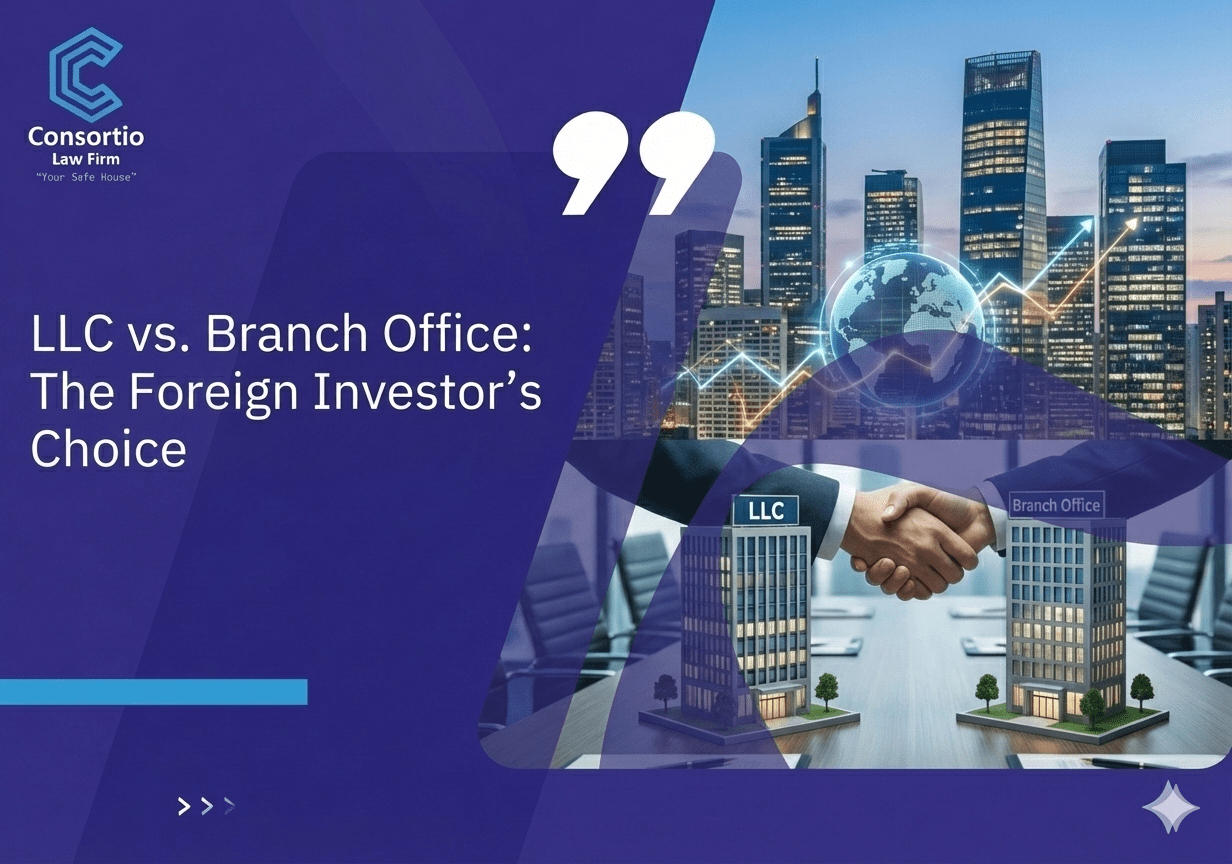
When entering the Egyptian market, foreign companies typically hesitate between two legal structures: the Limited Liability Company (LLC) and the Foreign Branch Office.
While both allow you to operate legally, they are fundamentally different vehicles regarding Liability, Taxes, and Commercial Scope. Choosing the wrong one can expose your global parent company to unlimited risk or lock your profits in a tax inefficiency loop.
At Consortio Law Firm, we guide international clients through this “fork in the road” daily. Here is the commercial reality of the choice.
1. The Branch Office: The “Direct Extension”
A Branch is not a separate legal entity; it is the parent company operating in Egypt.
The “Liability” Trap
Because the Branch is merely an extension, the Foreign Parent Company bears unlimited liability for the Branch’s debts, lawsuits, and obligations in Egypt.
-
Risk: If the Branch fails or faces a major lawsuit, the claimant can theoretically go after the assets of the Mother Company abroad.
The “Contract” Requirement
You cannot simply “open” a Branch. To register one, you generally need an existing public or private contract (e.g., a construction tender, an Oil & Gas concession) to perform work in Egypt.
The Tax Reality
-
Corporate Tax: 22.5% on net profits.
-
Profit Repatriation: Branch profits are treated as distributed dividends and are subject to a 5% or 10% withholding tax when transferred to the head office (depending on Double Taxation Treaties).
2. The Limited Liability Company (LLC): The “Firewall”
An LLC is a distinct legal entity, separate from its owners.
The “Liability” Shield
The liability of the foreign parent company is limited strictly to the value of the shares it owns.
-
Benefit: If the Egyptian LLC goes bankrupt, the Mother Company’s global assets remain safe. This “Corporate Veil” is the primary reason 90% of our clients choose the LLC.
Operational Freedom
Unlike a Branch, an LLC does not need a pre-existing contract to incorporate. You can register it today and bid for contracts tomorrow.
-
Scope: It can engage in trading, services, manufacturing, and commercial activities without restriction (except for specific strategic sectors).
The Ownership Myth
-
Myth: “I need an Egyptian partner.”
-
Reality: Under Investment Law No. 72, foreigners can own 100% of an LLC.
Strategic Note: The registration timeline for an LLC is often faster than a Branch because it does not require validating foreign contracts. For the full setup roadmap, see our Ultimate Guide to Company Formation in Egypt.
3. Side-by-Side Comparison
| Feature | Limited Liability Company (LLC) | Foreign Branch Office |
| Legal Personality | Independent Legal Entity | Extension of Parent Company |
| Parent Liability | Limited (Safe) | Unlimited (Risky) |
| Requirement | None (Capital Deposit only) | Must have an active contract in Egypt |
| Management | Manager (Foreigner allowed) | Branch Manager |
| Profit Tax | 22.5% | 22.5% |
| Best For | Commercial Entry, Sales, SMEs | Construction, Gov. Tenders, Oil & Gas |
The Verdict: Which One?
Choose the Branch Office ONLY if:
-
You are a contractor with a specific government tender that requires it.
-
You are in the Oil & Gas sector (concession agreements).
Choose the LLC if:
-
You want to protect the Mother Company from Egyptian liability.
-
You want to trade, sell services, or manufacture freely.
-
You want a permanent presence that outlasts a single contract.
Secure Your Structure
Don’t expose your global assets to local risk. Contact Consortio Law Firm to engineer the legal structure that protects your bottom line.
Book a Structuring Consultation
“For a broader look at the full Incorporation timeline and requirements beyond just the legal structure, read our Ultimate Guide to Company Formation in Egypt (2026).”