Egypt offers a fertile environment for investment, but navigating its procedural and regulatory landscape often requires deep legal expertise. In this article, we examine the legal framework of the “Golden License” and share a success story of how we helped a strategic client transform a project threatened with suspension into a tangible industrial reality.
I. The Golden License: Concept and Legal Framework
The Investment Law No. 72 of 2017 introduced a paradigm shift to simplify procedures, most notably through Article (20) regarding the “Golden License”.
The Golden License is a “single approval” issued by a Cabinet decree, which is effective by itself without the need for any other procedures. This approval is granted to companies establishing strategic or national projects and covers:
-
Establishing, operating, and managing the project.
-
Building permits.
-
Allocating the necessary real estate.
The goal of this license is to consolidate months or years of traditional licensing into one comprehensive approval, making it the ultimate target for any serious investor.
II. Case Study: A Major Saudi Investment in the Beverage Sector
This case represents a model of serious Foreign Direct Investment (FDI). The client is an Egyptian company (Enpro for Investment – a Single Person Company) , owned by a major Saudi entity (Energy Investment Company for Industry Ltd.).
The client aimed to establish a sophisticated factory for manufacturing and bottling carbonated beverages, with substantial investments exceeding 8 million Euros.
Project Scope:
-
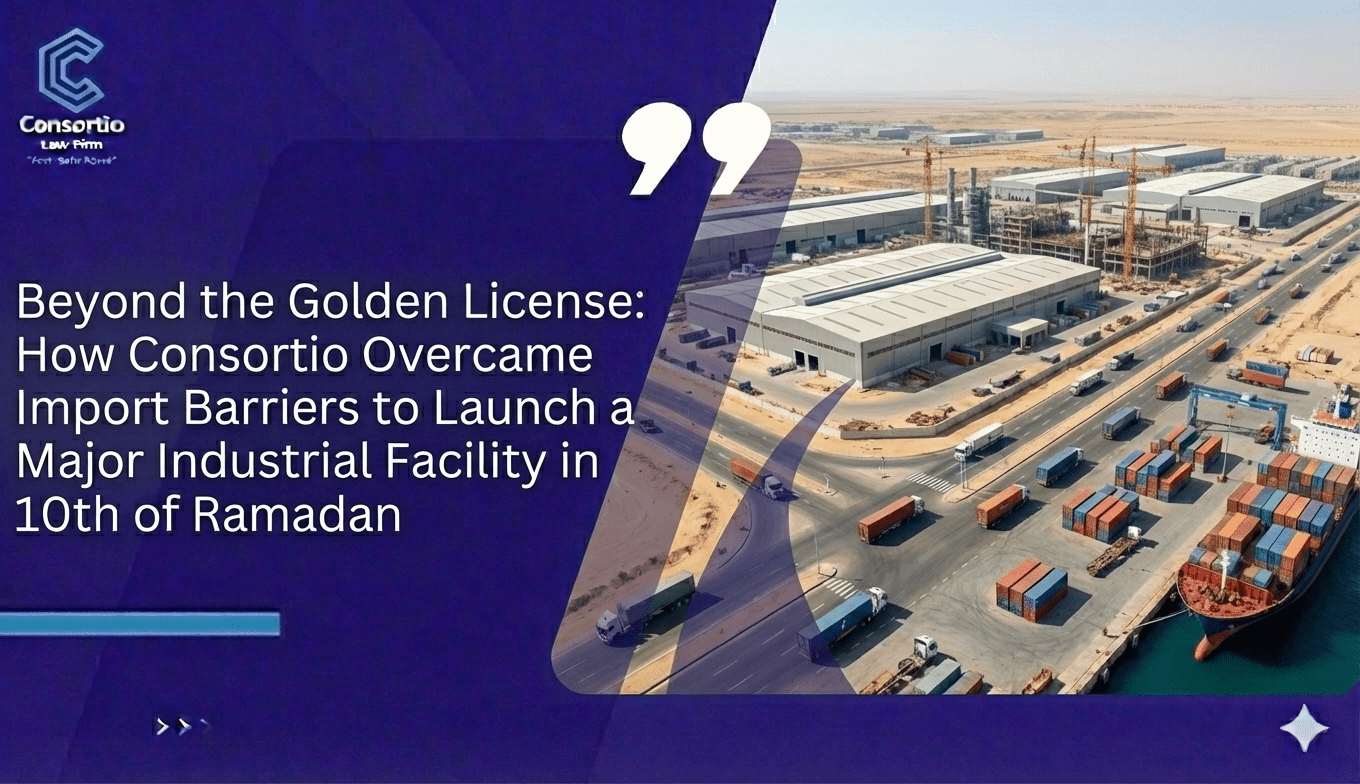
Location: The Industrial Zone in 10th of Ramadan City, spanning a vast area of 40,000 square meters.
-
Technology: The client contracted production lines from Krones, a global leader in bottling and packaging technology, to ensure the highest quality for the final product.
III. The Legal Dilemma: Is the Golden License Always the Answer?
The client’s initial desire was to apply for the Golden License, given the magnitude and strategic importance of the investment. However, a critical legal nuance emerged here that we wish to clarify for investors:
For the Golden License to serve its purpose and be procedurally accepted, it is preferable for the project to be in its initial stages (Greenfield Investment)—specifically, before purchasing the land and obtaining building permits.
In our client’s case, the factory had already been built, and construction was in advanced stages. Here, Consortio’s legal opinion was transparent and pragmatic: “Applying for the Golden License at this stage might face rejection due to the lack of necessity (as the construction licenses it would replace had already been obtained), potentially wasting valuable time.”
Therefore, we had to steer the strategy toward the real battle threatening the entire project: Importing the Production Lines.
IV. Crisis Management: Breaking the Bottleneck Amid Import Restrictions
The project faced an existential challenge coinciding with a difficult period when the Central Bank of Egypt imposed strict restrictions on imports and foreign currency availability.
Regulations required the submission of “Form 4,” which mandated that the full value of imported goods be paid or covered 100% in cash prior to shipment.
Why was this a problem? The Krones production line cost millions of Euros. Commercially, paying this amount upfront in a single lump sum was impossible. The standard practice for such investments is scheduled payments (installments) financed by the parent company abroad.
Strictly applying the “Form 4” requirement simply meant: Canceling the deal, halting the project, and losing the investments already poured into construction.
Consortio’s Legal Solution: We did not stand idle before standard banking procedures. Our legal team immediately moved to the highest executive level:
-
Direct Engagement: We submitted formal, exceptional requests to the Cabinet and the Ministry of Trade and Industry.
-
Legal Reclassification: We leveraged the authority of the Minister of Trade and Industry to grant exceptions. We reclassified the import of the production line as “Import for Private Use” of a capital production asset financed from abroad, rather than a commercial import requiring local currency sourcing.
-
The Approval: We successfully secured an exceptional approval to allow the entry of the production lines without the restriction of submitting the banking “Form 4.”
Conclusion: From Legal Papers to Tangible Reality
Based on this decisive legal intervention:
-
The purchase of the production line was fully financed by the parent company in Saudi Arabia.
-
The complex production lines arrived at Egyptian ports, were cleared, transported, and successfully installed inside the factory in 10th of Ramadan.
Today, the factory stands tall, and the Krones production lines are fully installed. At Consortio, we are currently finalizing the Operating License and Industrial Register, readying the wheels of production to turn, crowning a success story that began with an investment vision and was protected by strategic legal planning.
At Consortio, we don’t just provide legal advice; we clear the path for investment.
Is Your Industrial Project Stuck in Procedures?
Whether you are facing import restrictions (Form 4), need a Golden License assessment, or require an exceptional approval for your production lines, Consortio has the precedent and the know-how to unblock your investment.
Don’t let bureaucracy stop your machinery.
Contact our Industrial Investment Team: 📧 Email: Info@consortiolawfirm.com 📞 Phone: +201028806061