If you have read our General Counsel’s Guide to Commercial litigation, you know that the Egyptian legal system is a tiered hierarchy. But what happens if your judgment didn’t come from an Egyptian court at all?
A common scenario: A foreign investor wins a judgment in London or Dubai. They come to Cairo believing the battle is over. The Shock: To the Egyptian bailiff, that foreign judgment is just a piece of paper. It has no authority until it passes two hurdles: Legal Recognition (Exequatur) and Procedural Execution.
At Consortio Law Firm, we handle both. Below is the “Execution Reality” of how we turn a foreign verdict into money in the bank.
Part 1: The Legal Hurdle (Exequatur)
Before you can seize a single asset, the Egyptian court must “recognize” your foreign judgment. This requires filing a fresh lawsuit for an “Exequatur” (Order of Enforcement).
The “Reciprocity” Deal Breaker Under Article 296 of the Code of Civil Procedure, an Egyptian judge will only recognize a foreign judgment if the country where it was issued would enforce an Egyptian judgment.
-
The Risk: If you come from a jurisdiction that does not have a treaty with Egypt (like the US or UK), the court may refuse enforcement due to lack of reciprocity.
-
The Fix: If reciprocity is shaky, we may advise Re-litigation—filing a new case in Egypt using your foreign judgment as strong evidence rather than a binding order.
Crucial Step: The “Chain of Authentication”
Before filing, your foreign judgment must be “Egyptianized.” Egyptian courts will not look at a document unless it completes this specific chain:
-
Notarization: Notarized in the country of origin.
-
Consular Legalization: Stamped by the Egyptian Consulate in the issuing country.
-
MFA Authentication: Stamped by the Egyptian Ministry of Foreign Affairs in Cairo.
-
Certified Translation: Translated into Arabic by a certified office and bearing the official “Eagle Stamp” (Khatm Al-Nesr).
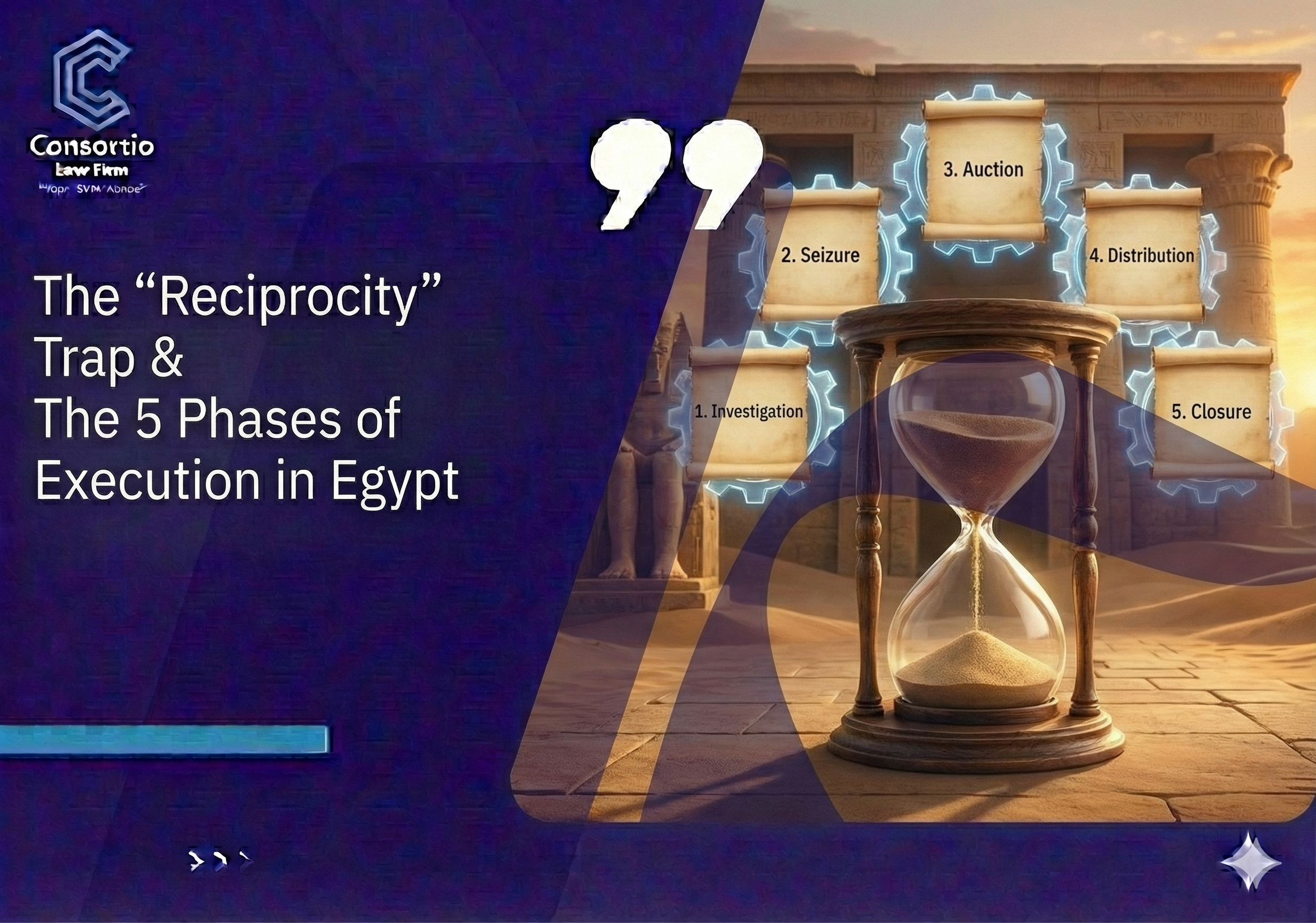
Part 2: The Procedural Reality (The 5 Phases of Execution)
Once the court grants the Exequatur, the actual work begins. We move through five distinct phases to secure your funds:
Phase 1: Notification of the Judgment
You cannot surprise a debtor with a seizure. The law requires that the debtor be formally notified of the judgment.
-
The Trap: Notification must be delivered to the “person concerned”. If sent to a generic mailbox, the entire execution can be challenged.
Phase 2: Provisional Attachment (Hajz Tahafouzi)
If we suspect the debtor is liquidating assets to avoid paying you, we do not wait for the final execution. We file for Provisional Attachment.
-
What it does: It freezes movable assets (like inventory or bank funds) to protect your rights while the legal process finishes.
-
Condition: We must prove there is doubt about the debtor’s ability to pay or a likelihood they will dispose of assets.
Phase 3: The Executive Formula (Al-Saygha Al-Tanfiziyah)
Winning isn’t enough. We must obtain the Executive Formula—the official document stamped by the court that explicitly commands the authorities to use force if necessary to execute the ruling.
-
Action: This document must be served to the debtor before we can move to final execution.
Phase 4: Determining the Execution Method
How we collect depends on what the debtor owns. We categorize execution into three types:
-
Assets in Debtor’s Possession: Seizing cash or goods physically located at their office.
-
Assets in Third-Party Hands: Freezing bank accounts or money owed to the debtor by their clients.
-
Real Estate Attachment: Seizing land or buildings. This is effective but slower.
Phase 5: The Client’s Role (Intelligence)
We are the lawyers, but you are the source of intel. For effective execution, you must provide us with specific data regarding the debtor’s assets.
-
What we need: Bank account details , lists of companies they deal with , their last known address , and details on any branch offices or warehouses.
Summary for Decision Makers
Enforcement in Egypt is not automatic; it is a process.
-
Check Reciprocity: Before you sue abroad, ask us if that judgment will be enforceable in Egypt.
-
Prepare the Docs: Ensure your judgment has the Egyptian Consulate Stamp before sending it to us.
-
Provide Intel: The speed of collection often depends on how quickly you can tell us where the debtor banks.
“Before you commit to a lawsuit, understand the actual timeline and execution risks in our detailed guide to Commercial Litigation in Egypt.”
“For complex disputes where confidentiality is critical, explore the strategic advantages in our Guide to Arbitration in Egypt.”