If you walk into an ordinary Egyptian Civil Court (Mahkama Ibtida’iya), you will see stacks of paper files tied with twine, crowded halls, and judges managing hundreds of miscellaneous cases—from rent disputes to petty theft—in a single day.
If you are a foreign investor, this is not where you want your commercial dispute to live.
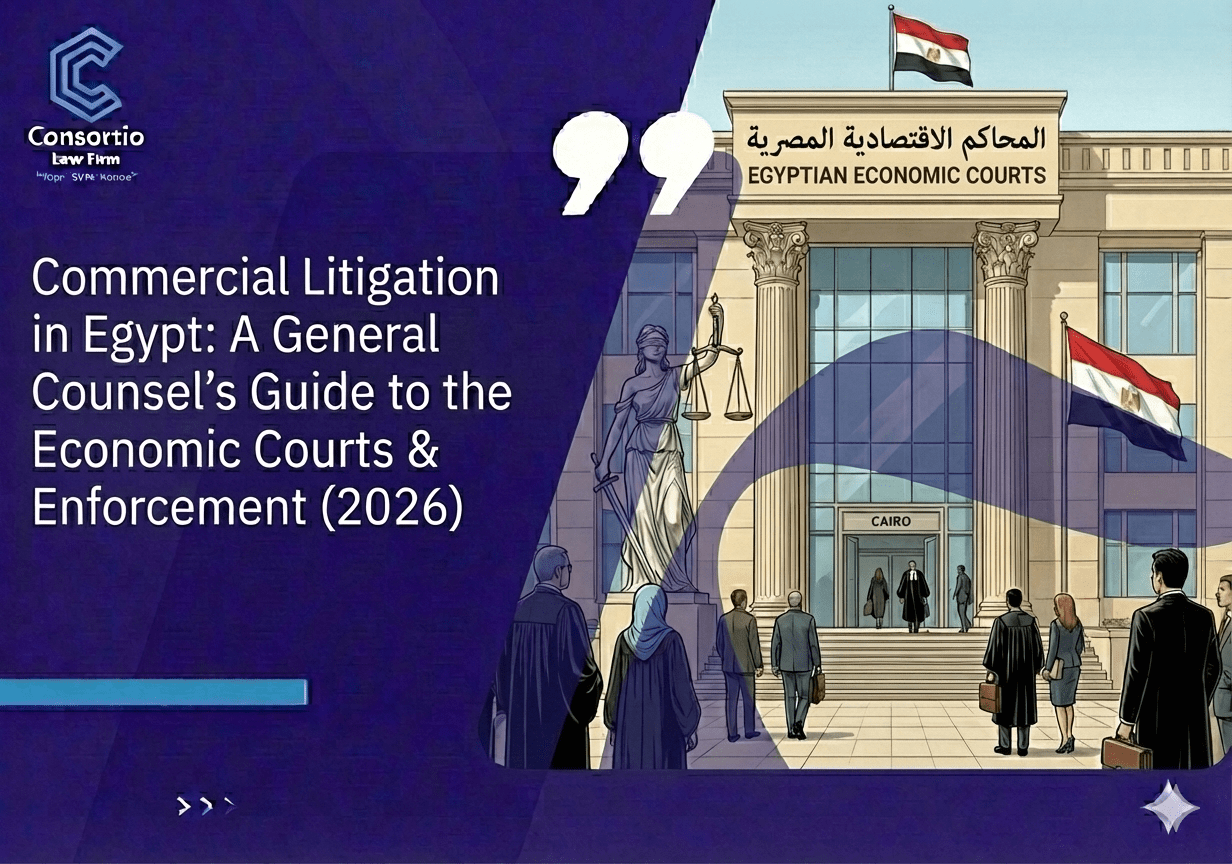
In 2008, Egypt recognized that modern business cannot survive 19th-century court procedures. The result was Law No. 120 of 2008, establishing the economic courts.
At Consortio, we view the economic court not just as a venue, but as a strategic asset. Here is the “Execution Reality” of why they matter and how to ensure your case lands there.
The Jurisdiction: Can You Get In?
Crucial Warning: You cannot simply “choose” the economic court because it is faster. Jurisdiction is specific and exclusive (Ikhtisas Naw’i) and is a matter of Public Order.
If your dispute does not fall under the specific laws listed below, the economic court will reject your case, sending you back to the slow lane of the Civil Courts.
The “Golden List”: The 17 Laws of Jurisdiction
To be accepted, the subject matter of your dispute must arise from the application of these specific laws (as updated by Law 146 of 2019):
-
Corporate & Investment: Companies Law, Investment Law, Bankruptcy & Restructuring Law.
-
Finance & Banking: Central Bank & Banking System Law, Capital Markets Law, Mortgage Finance, Financial Leasing & Factoring.
-
Technology & IP: Intellectual Property Rights (Trademarks/Patents), Telecommunications Regulation, E-Signature Law, Cybercrime Law.
-
Market Regulation: Protection of Competition, Consumer Protection, Regulation of Movable Guarantees, Insurance Supervision.
-
Transport: Maritime Trade Law, Civil Aviation Law.
Consortio Strategy: A standard “Breach of Contract” for a simple sale of goods often falls outside this list. We frequently see foreign contracts rejected because they were drafted as generic commercial agreements rather than specific “Agency” or “Banking” instruments. Drafting is your ticket in.
The “One-Tier” Advantage (The Time Saver)
This is the biggest secret of the economic courts.
In the ordinary system, you fight in the First Instance Court (1-2 years), and then you fight again in the Appeal Court (1-2 years).
However, economic courts of Appeal have a unique power. For high-value disputes or specific types of criminal/economic misdemeanors, the case starts directly at the Appeal level.
-
The Result: You cut the litigation timeline in half.
-
The Risk: You only get one shot. There is no “re-do” on the facts. Once the judgment is issued, your only recourse is the Court of Cassation (on points of law only), which rarely stays execution.
Specialized Judges
In a standard civil court, your judge might hear a divorce case at 9:00 AM and your complex M&A dispute at 9:15 AM.
In the economic courts, judges receive specialized training in commercial and financial laws. They understand what a “Letter of Credit” is without needing a 10-page explainer. This reduces the risk of “rogue rulings” based on a misunderstanding of business mechanics.
The Digital Reality
The economic courts were the pilot program for Egypt’s “E-litigation.”
-
The Theory: You can file cases and receive notifications electronically.
-
The Execution Reality: While better than civil courts, it is still a hybrid system. Physical presence is often required, and “electronic notification” can sometimes be challenged if the defendant claims they never received the email. We still rely on physical bailiffs for critical notifications to ensure the judgment is bulletproof.
Summary: The General Counsel’s Checklist
-
Check the Subject Matter: Does your dispute touch one of the “17 Laws”? If not, do not file here.
-
Check the Value: Is your dispute value high enough to skip the First Instance circuit?
-
Prepare for Speed: Because these courts move faster, the “Preparation Phase” (Expert Office) happens sooner. Do not file until your evidence is 100% ready.
“For complex disputes where confidentiality is critical, explore the strategic advantages in our Guide to Arbitration in Egypt.”