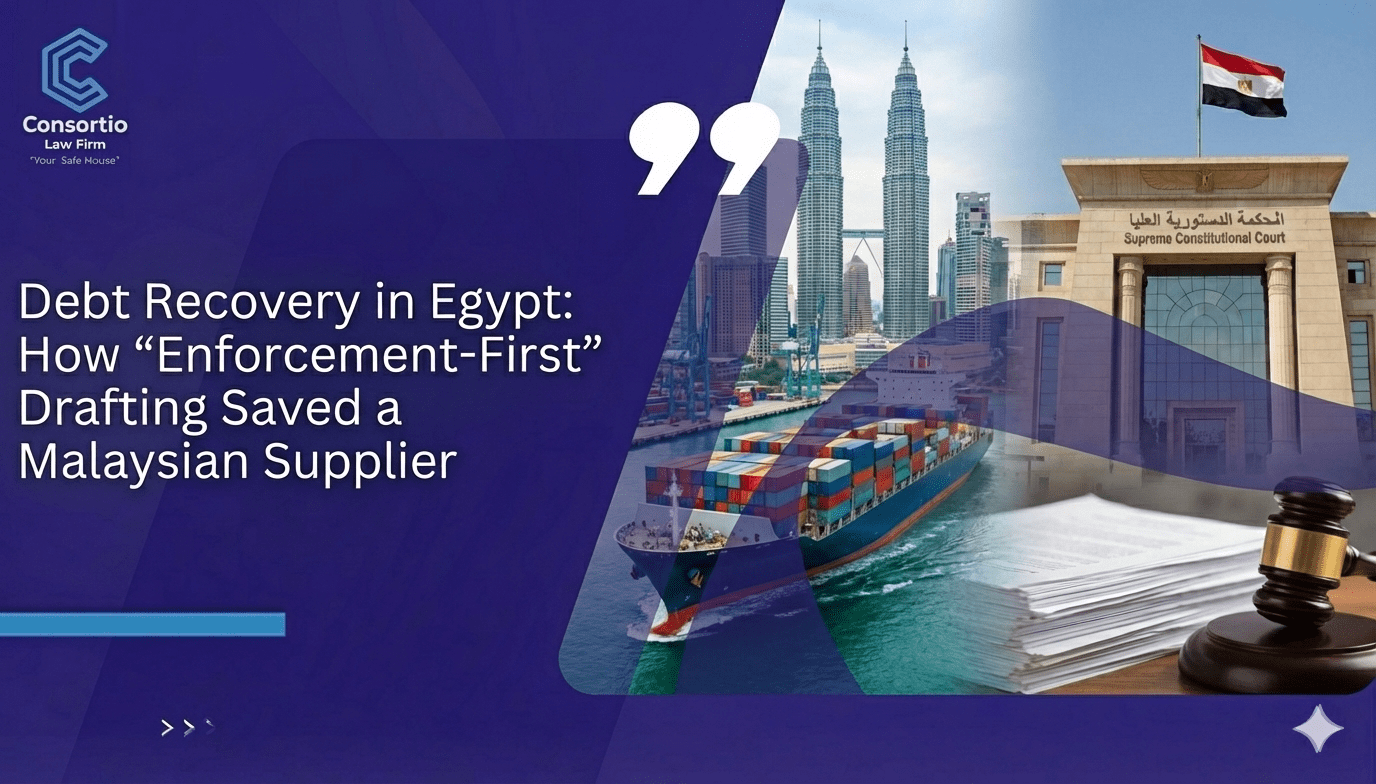
Case Study: Malaysian Exporter vs. Egyptian Importer
In cross-border trade, the most dangerous contract is the one that assumes everything will go well.
A Malaysian supplier learned this lesson the hard way. Engaged in a commercial relationship with an Egyptian importer, they shipped goods based on a contract drafted for “cooperation,” not “enforcement.” When the Egyptian counterparty stopped paying, the supplier discovered that their signed agreement was legally toothless in a local courtroom.
This case study explains how Consortio Law Firm transformed a stalled Debt Recovery file into a strategic overhaul of the client’s entire export framework.
The Background: The “Friendly Contract” Trap
The client had shipped a significant volume of goods to Egypt.
-
The Status: Delivery confirmed.
-
The Problem: Payment stalled. Communication stopped.
-
The Leverage: Zero.
When the client approached us, they expected us to file a lawsuit immediately. Our initial review revealed a harder truth: The contract was the problem. It contained payment obligations, but no “enforceable proof mechanisms.” It relied on email confirmations that Egyptian courts often dismiss. It had theoretical penalty clauses that would likely be voided by a judge.
The client was not just facing a bad debtor; they were facing a “litigation Dead-End.”
Our Method: Enforcement-First Architecture
We advised the client that throwing good money at a bad lawsuit was risky. Instead, we shifted the engagement from “Recovery” to “Restructuring.”
We applied our Enforcement-Driven Drafting Methodology to ensure this vulnerability never happened again.
Step 1: The Forensic Audit
We dissected the failed agreement to show the client exactly why they were stuck. We identified the specific clauses that stripped them of leverage—such as vague “Acceptance” criteria that allowed the debtor to delay payment indefinitely without technically defaulting.
Step 2: litigation-Backed Redrafting
For all future shipments, we engineered a new contract model based on Execution Reality:
-
Evidentiary Payment Triggers: We replaced vague payment terms with specific documentary triggers (e.g., Commercial Invoices linked to Customs Release forms) that serve as instant proof of debt in court.
-
The “Executive” Clause: We structured the debt acknowledgment to function as an “Executive Writ” where possible, allowing for faster enforcement execution rather than lengthy litigation.
-
Localized Penalties: We recalibrated the penalty clauses to align with the Egyptian Civil Code’s “Damage vs. Penalty” standards, ensuring a judge would uphold them.
The Outcome: From Victim to Secured Creditor
The engagement delivered two distinct results:
-
The Legacy Debt: By exposing the contract’s flaws, we advised the client to pursue a Commercial Settlement rather than a costly lawsuit. This pragmatism saved them years of legal fees on a weak case and recovered a portion of the funds through negotiation.
-
The Future Protection: The client now operates with a “Consortio-Engineered” contract. Since implementing the new framework, they have completed multiple subsequent shipments with zero payment defaults. The Egyptian counterparty knows that the new contract has “teeth.”
The Lesson: Recovery Problems are Drafting Problems
This case illustrates a critical principle for foreign exporters: Debt Recovery is a symptom. Bad Drafting is the disease.
If you wait until the invoice is overdue to call a lawyer, you are already too late. The real defense is a contract drafted to survive default, dispute, and execution.
Is your export contract enforceable in Egypt? Don’t wait for a default to find out. Contact our International Trade Team for a Contract Enforceability Audit.
📧 Info@consortiolawfirm.com