For foreign investors and General Counsels, debt collection in Egypt often feels like a maze. You hold a bounced check or a promissory note, and you simply want to enforce it.
The process involves two distinct stages: Obtaining the Judgment (via the “Payment Order” route) and Executing the Judgment (turning the paper into cash).
At Consortio, we believe in “Execution Reality.” This means being honest about the procedural hurdles—specifically, that the “fast track” Payment Order is often blocked by judges, and that real execution requires a precise 5-step protocol.
Part 1: The “Payment Order” (Amr Ada’): A Claim Route, Not a Guarantee
Many clients mistake the Payment Order for an immediate execution tool. It is not. It is a mandatory procedural route for filing a claim when the debt is fixed, written, and undisputed (Articles 201-210 of the Civil Procedure Code).
The Theory vs. The Reality
The Theory: You submit a petition to the judge in chambers, and within 3 days, they issue an order forcing the debtor to pay. No hearings, no delays.
The Execution Reality: Judges are extremely conservative. If the judge sees even a 1% chance of a dispute (e.g., a vague clause in the contract), they will issue a “Refusal to Issue” (Imtina’).
What happens next? The case is automatically transferred to the standard litigation track (pleadings, experts, hearings).
The Grievance (Tazallum): Even if the judge issues the order, the debtor has 10 days to file a “Grievance.” In practice, this Grievance almost always pauses the effect of the order and converts the matter into a full-blown lawsuit.
Consortio Insight: We prepare every Payment Order petition with the expectation that it might become a lawsuit. We ensure the evidence is “litigation-ready” from Day 1 to avoid delays if the judge refuses the initial order.
Part 2: The 5 Phases of Execution (How to Actually Collect)
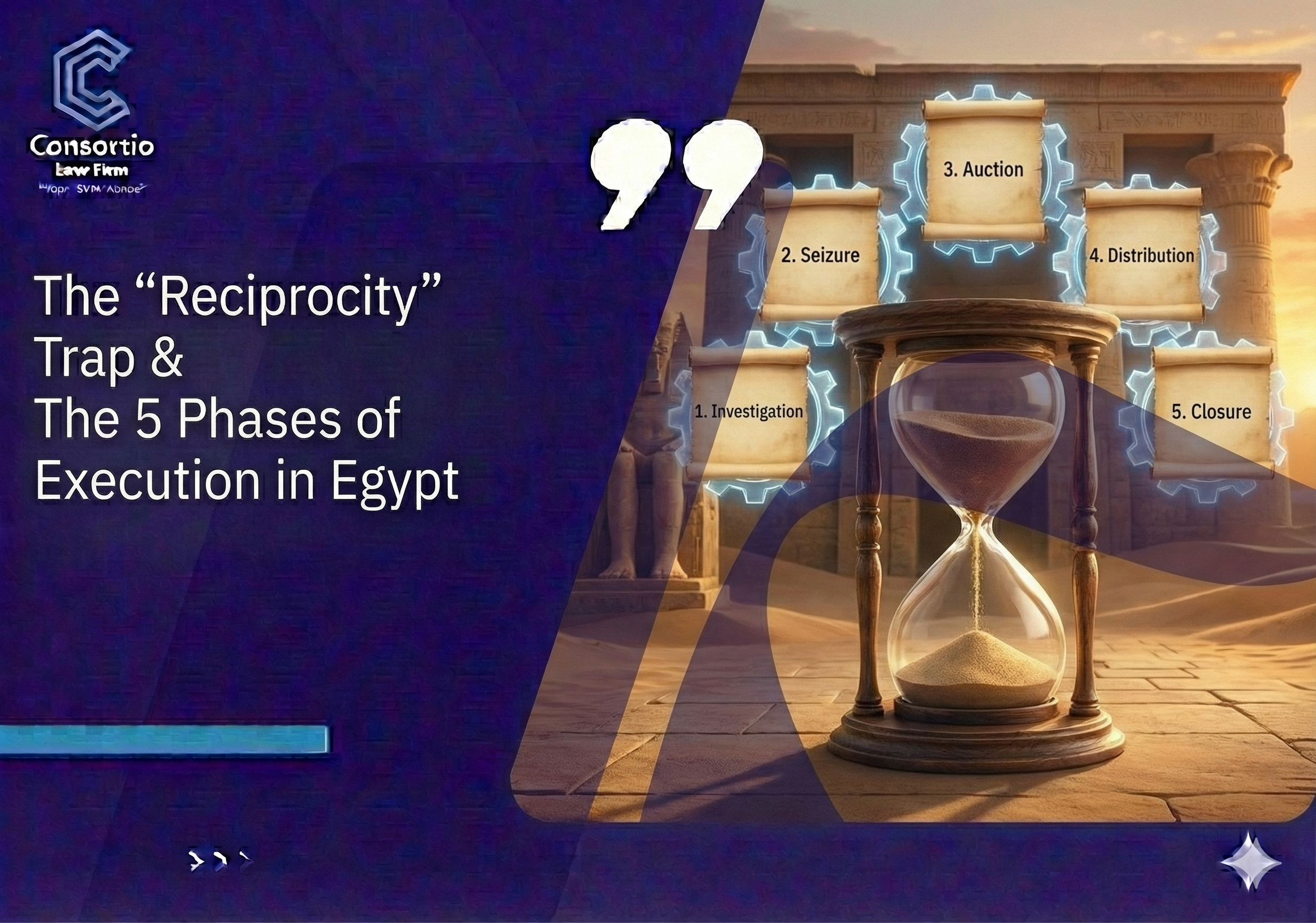
Whether you obtain a final Payment Order or win a standard lawsuit, you now have a judgment. But a judgment is not cash. Based on our internal enforcement protocols, we move through five strict phases to seize assets and recover your funds.
Phase 1: Notification of the Judgment (I’lan)
Execution cannot begin in secret. The law requires that the debtor be formally notified of the judgment or order.
Critical Detail: The notification must be delivered to the “person concerned” or their legal domicile. If the bailiff delivers it to the wrong address, the entire execution process can be annulled.
Phase 2: Provisional Attachment (Hajz Tahafouzi)
If we fear the debtor is liquidating assets to escape payment, we do not wait for the final execution measures. We file for Provisional Attachment.
Goal: To “freeze” movable assets (inventory, cars) or funds to protect your rights until the judgment is final.
Condition: We must prove the “risk of dissipation” to the judge.
Phase 3: The Executive Formula (Al-Saygha Al-Tanfiziyah)
This is the “Green Light.” The court issues the judgment on a specific document stamping it with the Executive Formula. This document commands the police and authorities to use force if necessary to execute the ruling.
Procedure: This official copy must be served to the debtor before we can proceed to forceful seizure.
Phase 4: Determining the Execution Method
We choose the seizure method based on where the debtor’s assets are hiding:
Seizure of Movables: We send bailiffs to the debtor’s HQ to seize cash, machinery, or inventory in their possession.
Garnishment (Third-Party Seizure): We freeze the debtor’s bank accounts or intercept funds owed to them by their own clients (e.g., seizing their accounts receivable).
Real Estate Seizure: We attach land or buildings. This is effective but involves longer procedures.
Phase 5: The Client’s Role (Intelligence)
We are the legal arm, but you are the intelligence hub. Effective execution relies on data provided by you.
What we need:
Bank Accounts: Branch details or account numbers.
Clients/Partners: Who owes them money? (So we can garnish it) .
Assets: Warehouses, fleets of cars, or branch offices.
Summary for the Finance Team
Payment Orders are a Process, Not a Magic Button: Be prepared for the judge to refuse the order or the debtor to grieve. It is often just the first step of a lawsuit.
Execution Requires Intel: The speed of collection depends heavily on knowing where the debtor banks.
Paperwork Matters: Without the “Executive Formula,” your judgment is just a piece of paper.
For a broader look at the court system, read our General Counsel’s Guide to Commercial Litigation.