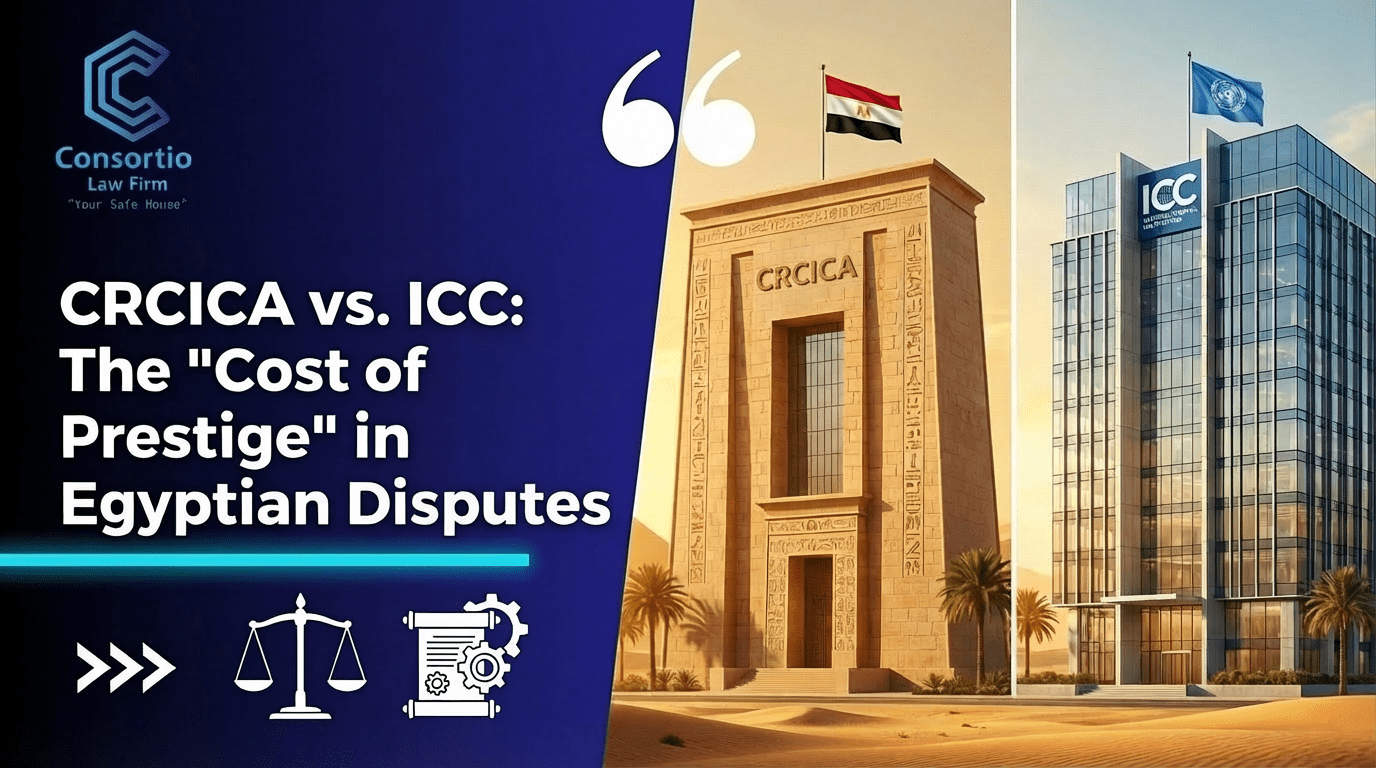
When drafting an arbitration clause, most foreign lawyers default to the International Chamber of Commerce (ICC) in Paris. It is the “safe,” prestigious choice.
But for a dispute centered in Egypt—involving Egyptian assets and Egyptian law—the ICC is often the expensive, logistical nightmare choice.
At Consortio Law Firm, we advise clients to look at the “Execution Reality.” Unless your dispute exceeds $50 million or involves multiple jurisdictions, the Cairo Regional Centre for International Commercial Arbitration (CRCICA) is often the superior strategic vehicle. Here is the data-driven comparison.
1. The Cost Differential (The CFO’s Argument)
Arbitration is not cheap, but the “institution” you choose dictates the burn rate.
The ICC (Paris)
-
Fee Structure: High administrative fees calculated in Euros.
-
Arbitrator Rates: ICC arbitrators often command top-tier international hourly rates ($500 – $1,000+ per hour).
-
The Hidden Cost: Travel. Every hearing requires flying your team, witnesses, and experts to Paris or London, plus hotels and per diems.
The CRCICA (Cairo)
-
Fee Structure: Significantly lower administrative fees, calculated in USD.
-
Arbitrator Rates: While you can still appoint international arbitrators, the “Administrative Fees” capped by CRCICA tables remain a fraction of the ICC’s.
-
The Savings: Hearings are held in Zamalek, Cairo. Your local engineering team and site managers can attend without visas or international flights.
Consortio Insight: For a standard construction dispute of $5M, choosing ICC over CRCICA can easily add **$100,000 to $200,000** in administrative and logistical overhead before the award is even written.
2. The “Seat” Matters More Than the “Name”
Many investors confuse the Institution (who organizes the coffee) with the Seat (who reviews the award).
-
Scenario A: You choose ICC Rules but the Seat is Cairo.
-
Result: You pay ICC prices, but the award is still subject to annulment by the Cairo Court of Appeal. You get “Paris costs” with “Cairo risks.”
-
-
Scenario B: You choose CRCICA Rules and the Seat is Cairo.
-
Result: You pay local prices, and the award is subject to the exact same court review.
-
Our Verdict: If the Seat is Egypt (mandatory for many public works contracts), there is rarely a commercial justification for paying ICC premiums.
3. Speed & Bureaucracy
-
ICC Scrutiny: The ICC Court scrutinizes every award before it is released. While this ensures high quality (less risk of annulment), it can add 3-6 months to the timeline.
-
CRCICA Speed: CRCICA checks the award for formalities but is generally faster in releasing the final document. In a cash-flow crisis, those 3 months matter.
4. The “Local Knowledge” Factor
CRCICA is deeply familiar with the Egyptian Civil Code.
-
The Risk with ICC: If you appoint a tribunal purely from London/New York to oversee an Egyptian construction dispute, they may misunderstand mandatory Egyptian public order provisions (like “Decennial Liability” for architects). This can lead to an award that is technically perfect but legally unenforceable in Egypt.
-
The CRCICA Edge: The institution is accustomed to hybrid panels (International Chair + Egyptian Co-Arbitrators) that bridge the cultural and legal gap.
Summary for the General Counsel
-
Choose ICC If: The dispute is cross-border (e.g., Egypt vs. Dubai), extremely high value ($100M+), or the counterparty is a sovereign state refusing local rules.
-
Choose CRCICA If: The project is in Egypt, the law is Egyptian, and you want to save 30% on procedural costs.
Decided on CRCICA? Ensure you use the correct Model Clause and understand the full process. Read our Master Guide: Arbitration in Egypt: A Foreign Investor’s Guide.