By Karim El Sayed, Managing Partner — Consortio Law Firm
A commercial contract dispute in Egypt does not announce itself.
It usually begins with something small. A payment that arrives late. An invoice that gets disputed. A delivery that does not meet specification. A local partner who stops responding. In most markets, these situations resolve through a phone call or a strongly worded letter. In Egypt, if the contract was not structured correctly, a small commercial friction can escalate into a multi-year legal process that consumes management time, ties up capital, and damages the relationship with every counterparty watching from the sidelines.
This article explains what actually happens — procedurally, commercially, and legally — when a commercial contract goes wrong in Egypt. Not the theoretical framework. The operational reality that foreign companies discover after the problem has already started.
The First 30 Days: When the Problem Is Still Manageable
Most commercial disputes have a window — usually the first 30 days after the breach becomes clear — when the cost of resolution is lowest and the options are widest.
In that window, the following decisions determine everything that follows.
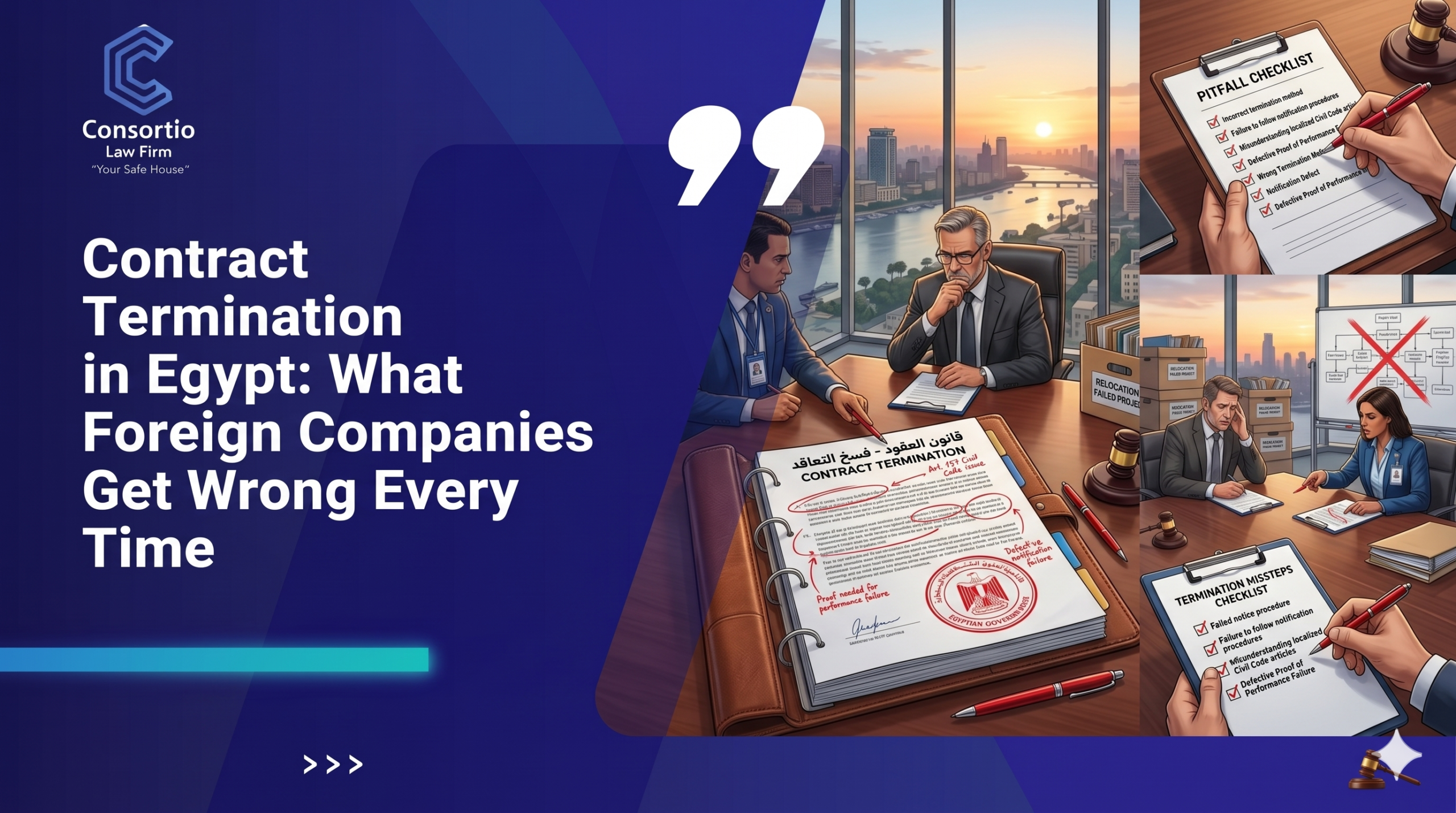
Do you have a valid, enforceable contract? This sounds like a baseline question, but it is not. Contracts executed between a foreign company and an Egyptian counterparty frequently contain one or more provisions that Egyptian courts will not enforce as written. A governing law clause that designates English law does not prevent an Egyptian court from applying Egyptian law if the contract relates to activity performed in Egypt. An arbitration clause without a named institution and a defined seat is unenforceable. A liquidated damages clause drafted at a level the court considers punitive rather than compensatory will be reduced or set aside. The contract that looked clean at signing may have structural problems that only appear when you try to use it.
What does your contract actually require you to do before taking legal action? Most well-drafted commercial contracts contain dispute resolution ladders — notice periods, cure periods, escalation requirements, mandatory negotiation stages before arbitration or litigation. Skipping these steps does not make the dispute go away. It gives the other side a procedural defence and potentially invalidates subsequent legal steps.
Is the breach clearly documented? Egyptian courts and arbitration tribunals work from evidence. The strength of your position one year from now will be determined by what you document today. This means formal written notices sent through channels that create a record — registered mail, official correspondence through legal counsel — not emails that go unanswered and WhatsApp threads that will never be admitted as evidence.
The foreign companies that manage Egyptian contract disputes well are the ones that treat day one as a legal exercise, not a commercial negotiation. Not because litigation is the goal — it rarely is — but because every step taken in the first 30 days shapes what is possible in month six.
What Happens If You Do Nothing
Doing nothing is the most common response to an emerging contract dispute in Egypt. The commercial team believes the relationship can still be saved. Regional headquarters wants to avoid escalation. Legal review is scheduled for “if it gets worse.”
Here is what “getting worse” looks like in practice.
The counterparty continues performing partially — enough to argue the contract is still alive, not enough to meet your commercial needs. This creates an ambiguous factual record. You cannot terminate cleanly because the breach is not total. You cannot claim full damages because partial performance continued. The contract limps forward for three to six months while both sides accumulate grievances and the commercial opportunity you entered Egypt to capture disappears.
Or: the counterparty stops performing entirely and begins building a counter-narrative. They claim you failed to meet a condition precedent. They allege the goods were defective or the services non-conforming. They raise a set-off against monies they claim you owe them from an earlier transaction. By the time you engage counsel, the dispute has been reframed from “they breached” to “both parties have claims” — a position that is far weaker for the party who waited.
Or: the counterparty takes the initiative. They file a precautionary attachment over your company’s assets in Egypt, or they initiate criminal proceedings related to a bounced check — a mechanism available under Egyptian law that transforms a commercial dispute into a criminal matter with immediate practical consequences for your operations.
The practical point: In Egyptian commercial disputes, the party that moves first — formally, documentarily, and legally — almost always has a structural advantage. Waiting does not preserve options. It surrenders them.
The Two Paths: Litigation and Arbitration
Once the informal resolution window has closed, the dispute moves toward one of two formal paths. Which path you are on is determined by what your contract says — and whether that provision is actually enforceable.
Commercial Litigation in Egyptian Courts
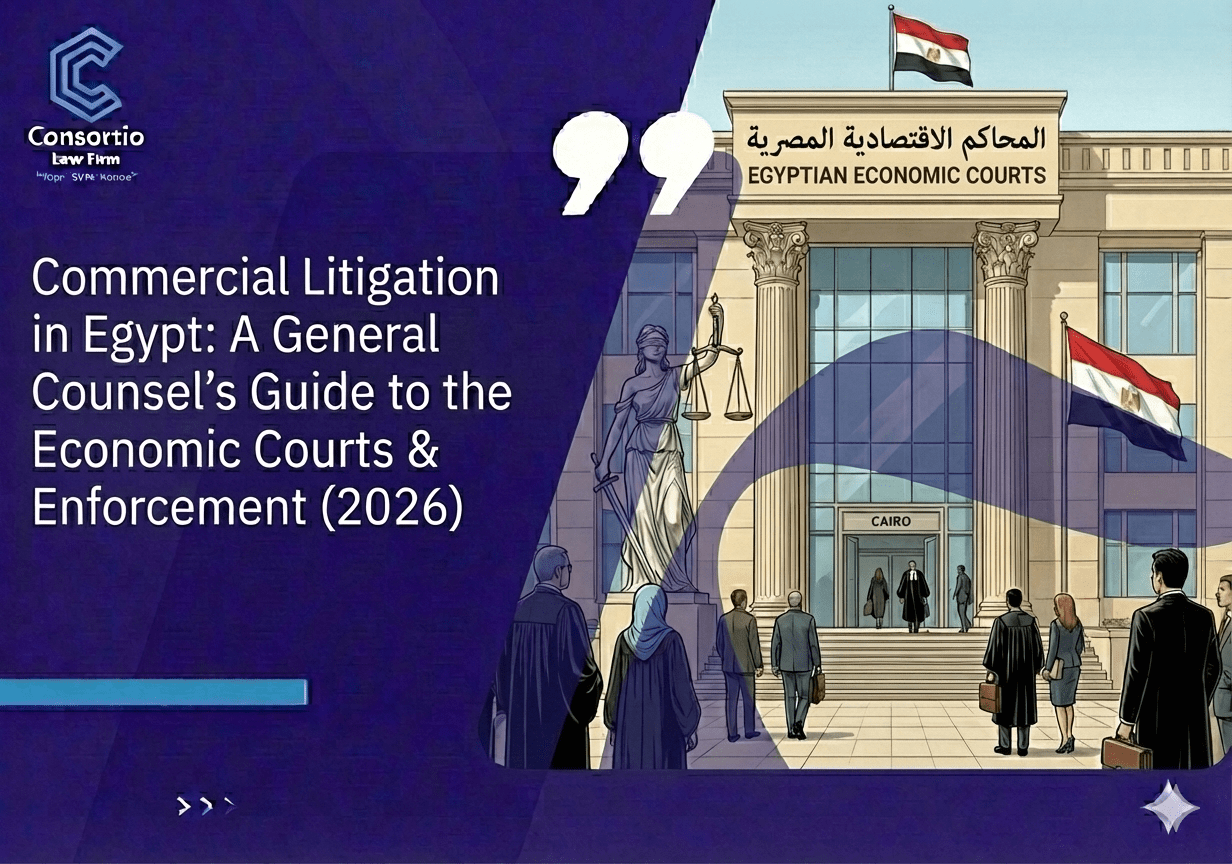
Egypt’s Economic Courts handle commercial disputes involving companies and business transactions. These are specialist courts with dedicated commercial divisions that move faster than general civil courts, though “faster” in this context means years, not months.
A commercial litigation timeline in Egypt:
Filing and service: The claim is filed, the defendant is served, and an initial hearing is scheduled. Depending on the court’s docket, the first substantive hearing may be four to eight weeks after filing.
Exchange of pleadings: Egyptian commercial litigation is a written process. Both parties file written memoranda — the claimant establishing its case, the defendant filing its defence, the claimant responding, and so on. Each exchange takes weeks. Complex disputes may see six to ten rounds of written pleadings over 12 to 18 months.
Expert appointment: In disputes involving financial calculations, technical assessments, or accounting questions, Egyptian courts routinely appoint a court-supervised expert. The expert examines the documents, visits premises if necessary, takes positions from both parties, and files a report. This stage alone can add six to twelve months.
Judgment and appeal: A first-instance judgment is issued. The losing party typically appeals, first to the Court of Appeal and — if a question of law is raised — to the Court of Cassation. For disputes in the Economic Courts — which handle most commercial matters involving companies — the timeline from filing to final resolution is typically one to three years. General civil court disputes that escalate to the Court of Cassation can extend to three to seven years, but commercial disputes between companies are referred to the Economic Courts, which operate on a significantly faster track.
The costs of commercial litigation in Egypt are recoverable in principle but rarely recovered in full in practice. More significantly, management time is not recoverable. Senior commercial and legal staff who spend 20 days per year over three years dealing with Egyptian litigation have a real cost that never appears in the legal fee invoice.
Arbitration
If your contract contains a valid arbitration clause — naming a seat, an institution, and a language — the dispute goes to arbitration rather than the Egyptian courts.
The main advantages of arbitration for foreign companies operating in Egypt:
Enforceability internationally. Egypt is a signatory to the New York Convention on the Recognition and Enforcement of Foreign Arbitral Awards. An arbitral award issued by a recognised institution — ICC, CRCICA, LCIA, or others — can be enforced in Egypt through a streamlined exequatur process, and can be enforced in most other jurisdictions where the losing party has assets.
Procedural control. Arbitration allows the parties to agree on language, applicable law, and procedural timetable. For a foreign company whose internal legal team works in English, a Cairo-seated arbitration conducted in English under CRCICA rules is a fundamentally different experience from Egyptian court litigation conducted entirely in Arabic with no translation rights.
Speed — relative to litigation. A well-managed commercial arbitration in Egypt can reach an award in 12 to 24 months. This is not fast by international standards, but it is meaningfully faster than litigation for high-value disputes.
The main limitation: arbitration is only available if the clause in the contract is valid and enforceable. An arbitration clause that fails — because it names no institution, or because it was included in a type of agreement where Egyptian law requires court jurisdiction — leaves the parties in the Egyptian courts regardless of what the contract says.
The Criminal Dimension: What Foreign Companies Do Not Expect
Egyptian commercial law contains a mechanism that foreign companies almost universally fail to anticipate: the intersection between commercial disputes and criminal law.
The most common scenario involves checks. In Egypt, issuing a check that is dishonoured for insufficient funds is a criminal offence under the Commercial Law, not merely a civil matter. A counterparty who holds a dishonoured check from your company can file a criminal complaint with the public prosecutor — and does not need a court judgment to do so. This converts what was a commercial payment dispute into a criminal case, with the practical effect of creating personal exposure for the company’s legal representative in Egypt.
Equally, a counterparty can file a criminal complaint alleging fraud or breach of trust in connection with a commercial transaction — even where the underlying matter is entirely contractual. Egyptian courts apply a criminal procedure that allows precautionary measures — travel bans on company representatives, attachment orders — before the case reaches substantive hearing.
This is not theoretical. Foreign company representatives have had travel bans imposed in connection with commercial disputes they considered straightforward contractual matters. The criminal complaint was filed strategically — not because it was likely to succeed on its merits, but because the travel ban and personal exposure created immediate pressure to settle on unfavorable terms.
The prevention: Foreign company legal representatives in Egypt should never hold cheques issued to business counterparties without understanding the check regime. Commercial contracts should be structured to avoid creating documents that can be weaponized through criminal procedure. When a dispute emerges, a criminal risk assessment is as important as a civil litigation assessment.
Recovering Money: The Enforcement Gap
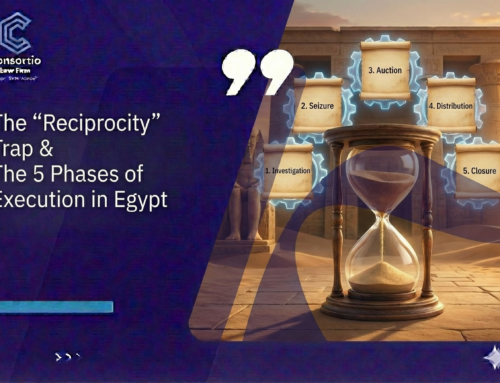
Obtaining a favorable judgment or arbitral award is not the end of a commercial dispute. It is the beginning of the enforcement process.
Egyptian enforcement courts handle the execution of judgments and awards. The practical reality:
A judgment or award against an Egyptian company with no attachable assets in Egypt, no real estate, and no bank accounts that can be frozen is worth nothing commercially. Foreign companies that litigate for two years, spend significant legal fees, and obtain a judgment find that the counterparty has structured itself to be judgment-proof.
The approach Consortio recommends is enforcement-first drafting: every commercial contract should be structured from the beginning with enforcement in mind. This means understanding what assets the counterparty holds in Egypt before signing, building contractual security mechanisms into the agreement — personal guarantees from beneficial owners, security interests over specific assets, structured check arrangements — and understanding what attachment mechanisms are available before the dispute arises rather than after.
A contract that cannot be enforced is not a contract. It is a document.
What Good Dispute Management Looks Like
The foreign companies that handle Egyptian commercial disputes well share four characteristics.
They have contracts that work under Egyptian law. Not contracts that were translated into Arabic but retain the structure of an English-law template. Contracts that were drafted by lawyers who understand how Egyptian courts interpret commercial agreements — the specific clauses that Egyptian courts will enforce literally, the clauses they will rewrite, and the clauses they will disregard.
They document everything formally from the beginning. When a problem emerges, the first response is a formal written notice through legal counsel — not a relationship call, not an email, not a WhatsApp message. The formal notice creates the record. Everything after it builds on that record.
They assess the full dispute landscape before acting. Civil exposure, criminal exposure, enforcement options, counterparty asset position, applicable arbitration or litigation path — all of this is assessed in the first week, not after six months of failed negotiation.
They understand that settlement is a legal strategy, not a commercial retreat. Most commercial disputes in Egypt settle. The question is when and on whose terms. A party that has built a strong legal position — formal notices, a defensible contract, a credible enforcement path — settles on better terms than a party that has been reacting. Settlement is not a departure from the legal process. It is a product of it.
The Core Principle
A commercial contract dispute in Egypt is not fundamentally different from a commercial dispute anywhere else. It involves a breach, a claim, a response, a resolution. What is different is the procedural environment, the enforcement mechanics, and the criminal dimension that exists alongside the civil framework.
Foreign companies that understand this environment before they enter a dispute manage their disputes efficiently and resolve them well. Foreign companies that discover it after the dispute has started spend the first six months learning the environment at their own expense.
The best time to understand what happens when a commercial contract goes wrong in Egypt is before you sign the commercial contract.
Karim El Sayed is the Managing Partner of Consortio Law Firm, a Cairo-based legal institution serving international companies operating in Egypt across market entry, compliance, and commercial dispute resolution.
For a confidential assessment of a current contract dispute or a review of your commercial contract framework in Egypt, contact Consortio at info@consortiolawfirm.com or +20102880 6061.